Thermally Broken Aluminium Shopfront U Values and Condensation Control
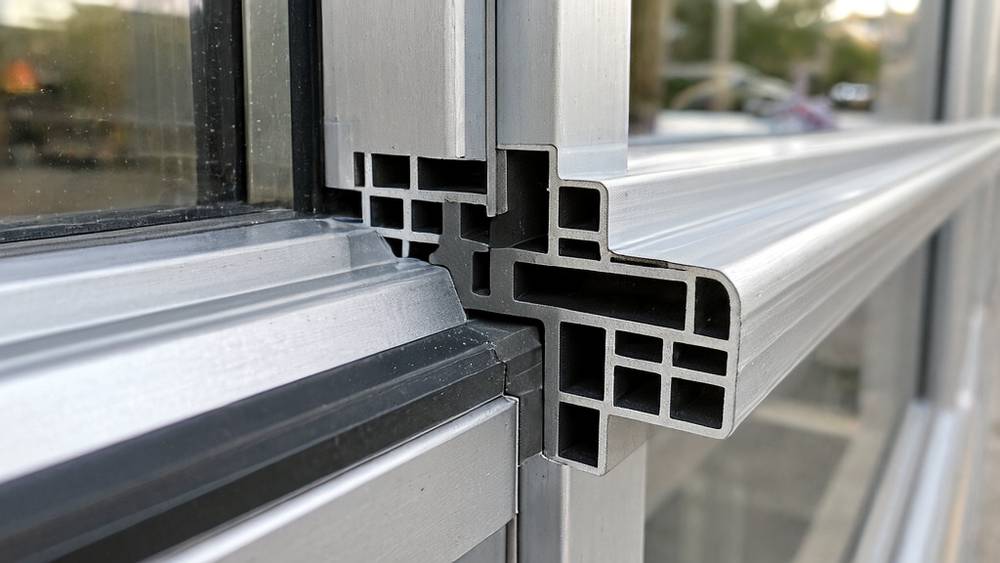
Retail frontage design has shifted. Where shopfronts once served as simple barriers between street and store, they now function as revenue-generating architectural assets. The aluminium shopfront sits at the centre of this shift. A well-specified system pulls foot traffic, reduces long-term maintenance costs, and withstands the relentless abrasion of urban high streets. But across procurement desks and contractor meetings, one question keeps surfacing: how do polyamide thermal break profiles compare against traditional single-piece extruded sections for street-level commercial entrances, and what do the U-value differences actually mean for condensation control in temperate climates?
The answer matters more than most project teams realise. A specification decision made during tender stage echoes across the entire service life of the installation. Get it wrong, and the shopfront becomes a liability: internal condensation pooling on threshold plates, cold bridging that drives energy loss, and frames that move just enough to compromise gaskets. Get it right, and the aluminium shopfront delivers 30-plus years of thermal and structural performance with minimal intervention. This article examines the technical distinction between thermally broken and non-thermally broken aluminium shopfront systems, provides real U-value data, and maps out where each configuration makes engineering and commercial sense.
The Thermal Break Question Nobody Asks Until It Is Too Late
Standard aluminium shopfront sections, extruded as single profiles from 6063-T6 alloy, conduct heat efficiently. That is the problem. Aluminium's thermal conductivity sits around 160 W/m·K, which means an unbroken frame acts as a thermal bridge between conditioned interior space and external ambient air. In winter, the internal frame face drops below dew point. Moisture condenses. It runs down the glass, pools on the bottom rail, and eventually corrodes ironmongery or seeps into floor finishes.
Thermally broken profiles address this by inserting a polyamide (PA66 GF25) strip between the inner and outer aluminium extrusions. The glass-fibre-reinforced nylon barrier has a thermal conductivity of approximately 0.30 W/m·K, three orders of magnitude lower than the aluminium it separates. The two aluminium halves are mechanically crimped together under controlled pressure, creating a composite profile that maintains structural integrity while slashing thermal transmittance.
The engineering is mature. What remains inconsistent across the supply chain is when to specify it. Many aluminium shopfront tenders default to the cheapest compliant option: non-thermally broken sections that meet structural requirements but ignore the operational energy and condensation realities of the building. Contractors who have lived through winter callbacks understand the difference. Those who have not often learn the hard way.
U-Value Benchmarks: What the Numbers Actually Mean
Thermal transmittance through an aluminium shopfront assembly is not governed by the frame alone. The total U-value (Uf for frame, Ug for glazing, combined as Uw for the whole window/shopfront) depends on the ratio of frame to glass, spacer bar technology, and the glazing specification itself. That said, the frame contribution is the variable that specifiers most frequently overlook.
Independent testing to EN 12412-2 and ISO 10077-2 provides the following typical ranges for aluminium shopfront frame sections:
| Frame Configuration | Typical Uf Value (W/m²·K) | Condensation Risk (Internal RH 50%, 0°C External) | Typical Application |
|---|---|---|---|
| Standard single-piece extrusion (no thermal break) | 5.0 – 7.0 | High: frame internal face drops below dew point at external temps below 5°C | Open-front canopies, unheated retail arcades, industrial units |
| Basic thermal break (PA66, 18–24 mm strip) | 2.8 – 3.5 | Moderate: risk below -5°C external | High-street retail, heated commercial entrances, Part L compliance (UK) |
| Advanced thermal break (PA66, 30–42 mm multi-chamber strip) | 1.6 – 2.4 | Low: risk below -15°C external | Passivhaus-adjacent retail, banks, premium hospitality frontages |
| Ultra-high-performance (PA66 + low-E insert film + foam fill) | 0.8 – 1.4 | Negligible under normal temperate climate conditions | Certified Passivhaus components, net-zero retail units |
These frame U-values combine with glazing to produce the overall assembly rating. A thermally broken aluminium shopfront frame at Uf 2.4 paired with double-glazed low-E units (Ug 1.1) and warm-edge spacers typically achieves Uw around 1.6–1.8 W/m²·K. That sits comfortably within UK Building Regulations Part L (2022 edition) requirements for new commercial buildings, where the limiting U-value for doors and high-traffic entrances is 1.8 W/m²·K. A non-thermally broken equivalent struggles to reach 3.0 W/m²·K without exotic glazing that blows the budget.
Polyamide Strip Geometry: Not All Thermal Breaks Are Equal
Procurement teams sometimes treat "thermally broken" as a binary checkbox. It is not. The performance difference between a basic 18 mm polyamide strip and a 34 mm multi-chamber profile can exceed 1.0 W/m²·K in frame U-value. That gap translates directly into heating energy costs over the 30-year service life of a typical aluminium shopfront.
The critical variables in polyamide strip design include:
- Strip depth (I-value): Measured in mm, this is the distance between the inner and outer aluminium profiles. Larger depth increases the thermal path length and reduces heat flow. Standard commercial strips range from 18 mm to 42 mm. Each additional 5 mm typically reduces Uf by 0.2–0.3 W/m²·K, though diminishing returns set in beyond 35 mm.
- Chamber geometry: Basic strips are solid or single-chamber. Advanced strips incorporate multiple hollow chambers that create still-air pockets, further reducing conductive and convective heat transfer. Three-chamber designs are common in the 2.0 W/m²·K performance band.
- Glass-fibre content: PA66 GF25 (25% glass fibre by weight) is the industry standard, balancing mechanical strength with thermal performance. Lower glass content reduces strength; higher content increases thermal conductivity. The 25% formulation represents the settled engineering compromise.
- Low-E film integration: Some premium strips incorporate a low-emissivity film within the polyamide profile, reflecting radiant heat back into the interior. This can reduce Uf by an additional 0.2–0.4 W/m²·K without increasing strip depth.
For aluminium shopfront projects where energy performance is contractually specified, the polyamide strip specification deserves the same scrutiny as the glazing schedule. A project that specifies argon-filled triple glazing but pairs it with a basic 20 mm thermal break is leaving performance on the table at the frame-glazing interface.
Condensation and the Dew Point: Why It Drives Callbacks
Condensation on an aluminium shopfront is not a cosmetic issue. Persistent moisture on internal frame surfaces supports mould growth, degrades sealants, corrodes steel reinforcement inside the frame, and creates slip hazards on polished threshold plates. In retail environments, condensation fogging on the internal glass face obstructs product visibility, which directly undermines the shopfront's commercial function.
The physics is straightforward. At 20°C internal air temperature and 50% relative humidity, the dew point is approximately 9.3°C. When the internal surface temperature of the frame or glass edge drops below that threshold, condensation forms. A non-thermally broken aluminium frame at 0°C external will have an internal surface temperature around 3–5°C, well below dew point. Condensation is guaranteed.
A thermally broken frame with Uf 2.4 under the same conditions maintains an internal surface temperature of approximately 14–16°C, safely above dew point. The margin narrows as external temperature drops, but the thermal break extends the condensation-free operating range significantly. For heated retail spaces in northern European climates, this alone justifies the specification upgrade.
Futeng® aluminium shopfront systems, manufactured with precision-crimped PA66 thermal break technology, are supplied to contractors across Europe and Asia-Pacific markets where condensation performance is a contractual requirement. The engineering focus sits on consistent crimping pressure across the full extrusion length, ensuring no thermal bypass gaps develop over time.
Structural Implications of Thermal Break Integration
Splitting an aluminium extrusion into two halves and reconnecting them with polymer introduces a structural discontinuity. The polyamide strip must transfer shear forces between the inner and outer profiles while resisting the bending moments that wind load and operational use impose on the aluminium shopfront assembly.
PA66 GF25 strips are engineered to handle this. The material's tensile strength (approximately 100–120 MPa for conditioned material) and shear strength (around 70 MPa) are sufficient for standard shopfront applications when the strip geometry is correctly specified. However, three structural considerations demand attention:
- Moment of inertia reduction: The composite profile's effective moment of inertia (Ieff) is lower than an equivalent monolithic section because shear lag across the polyamide strip reduces composite action. Designers apply a reduction factor (typically 0.7–0.85 depending on strip geometry) when calculating deflection under wind load. For shopfronts with large uninterrupted glazing panels where frame deflection must stay below L/175 or 15 mm (whichever is less), this reduction can push sections up by one size.
- Thermal expansion differential: Aluminium expands at approximately 23 × 10⁻⁶ /K; PA66 GF25 at roughly 30 × 10⁻⁶ /K. Over the height of a 3-metre shopfront frame, a 40°C temperature swing produces a differential movement of about 0.8 mm. This is accommodated by the crimping profile design and does not normally cause serviceability issues, but it must be factored into joint detailing and gasket selection.
- Impact resistance: Shopfronts in high-traffic retail environments face trolley impacts, door slams, and occasional vandalism. Thermally broken sections have slightly lower impact resistance than monolithic extrusions because the polyamide strip can deform under point loads. For aluminium shopfront installations in particularly aggressive environments, specifying a deeper strip with thicker wall sections around the crimp zone restores robustness.
Cost Comparison: Thermal Break Premium vs Lifecycle Payback
The procurement conversation around thermally broken aluminium shopfront systems often stops at the upfront cost differential. This is short-sighted but common. Here is a representative cost comparison based on a typical 10-metre-wide, 3-metre-high aluminium shopfront with double entrance doors, priced at 2025 UK market rates (supply only, excluding installation and glazing):
| Cost Element | Non-Thermally Broken (£) | Thermally Broken, 24 mm Strip (£) | Delta |
|---|---|---|---|
| Frame sections (mullions, transoms, cills, head channels) | 3,200 | 4,100 | +28% |
| Door leaf profiles and thresholds | 1,800 | 2,200 | +22% |
| Gaskets, seals, and thermal isolation pads | 350 | 520 | +49% |
| Ironmongery (thermally isolated hinges, locks) | 600 | 750 | +25% |
| Total material cost (supply only) | 5,950 | 7,570 | +27% |
The £1,620 premium looks significant on a tender comparison sheet. But placed against a 30-year service life and the energy cost of heating a retail unit, the arithmetic shifts. A thermally broken aluminium shopfront assembly at Uw 1.7 saves approximately 45–60 kWh per square metre per year compared to a non-thermally broken assembly at Uw 3.0, based on temperate climate heating degree-day data. For a 30 m² shopfront, that equates to 1,350–1,800 kWh annually. At current UK commercial electricity rates of approximately £0.25/kWh, the annual saving is £340–450. The thermal break premium pays back within four to five years through energy alone, before accounting for avoided condensation damage and maintenance.
Regulatory Drivers: What Building Codes Actually Require
The thermal performance requirements for aluminium shopfront installations are tightening across multiple jurisdictions. Specifiers who treat thermal break decisions as optional may find themselves on the wrong side of compliance:
- UK Building Regulations Part L (Conservation of Fuel and Power), 2022 edition: New commercial buildings must achieve limiting U-values of 1.8 W/m²·K for doors and high-usage entrances. This effectively mandates thermally broken aluminium shopfront frames for heated commercial spaces unless compensatory measures are applied elsewhere.
- EU Energy Performance of Buildings Directive (EPBD) recast: Member states are required to implement minimum energy performance standards for building envelopes. Several northern European countries (Germany via GEG, Netherlands via BENG) now enforce Uw limits below 2.0 W/m²·K for commercial entrances, which makes thermal breaks a de facto requirement.
- AS 2047 (Australia) and NCC Section J: While Australia's climate varies dramatically, NCC Section J energy efficiency provisions for commercial buildings in climate zones 7 and 8 (cool temperate and alpine) impose glazing and frame U-value limits that push aluminium shopfront specifications toward thermally broken solutions.
The direction of regulatory travel is unambiguous. Standards are tightening, not relaxing. An aluminium shopfront specified today without a thermal break may require retrofit upgrading within 15 years as energy performance requirements ratchet upward. Forward-thinking specifiers are already defaulting to thermally broken profiles for any heated commercial interior, treating the non-thermally broken option as appropriate only for open canopies, unheated storage areas, and purely decorative façade elements.
Glazing Pairing: Don't Undermine the Frame Investment
Specifying a high-performance thermally broken aluminium shopfront frame and then glazing it with basic clear double-glazed units is a mismatch that wastes the frame investment. The frame and glazing must be specified as a system, with U-values balanced to avoid a weak link.
For a thermally broken aluminium shopfront frame at Uf 2.0–2.4, the appropriate glazing companion is a double-glazed unit with low-E coating (ε ≤ 0.05) on surface #3, argon fill (90% minimum), and warm-edge spacer bar (stainless steel or structural foam, not aluminium box spacer). This combination typically delivers Ug 1.0–1.2, producing an overall Uw in the 1.5–1.7 range. For frames with advanced thermal breaks (Uf 1.4–1.8), triple glazing becomes the logical partner, pushing Uw toward 1.0–1.2.
The warm-edge spacer bar deserves particular attention. Traditional aluminium box spacers create a thermal bridge at the glass edge, reducing the effective edge temperature by 2–4°C compared to warm-edge alternatives. In an otherwise well-engineered aluminium shopfront, the spacer bar becomes the condensation weak point. The cost increment for warm-edge spacers is modest (approximately £2–4 per linear metre of perimeter), and the condensation avoidance benefit is substantial.
Installation Factors That Affect Thermal Performance
Even the best-engineered thermally broken aluminium shopfront profile underperforms if installed without attention to thermal continuity. Three installation details frequently degrade as-built U-values:
Perimeter thermal bridging at the structural opening. When an aluminium shopfront frame is fixed directly to a concrete slab edge or steel lintel without a thermal isolation layer, heat conducts around the frame through the building structure. A 10 mm thermal break pad (compressible polyethylene or polyurethane foam strip) between the frame back and the structural opening restores continuity. This detail is often omitted on site because it is not explicitly drawn.
Through-frame fixings. Steel screws that penetrate from the external frame face into the internal profile or the building structure create point thermal bridges. Each fixing becomes a condensation nucleation point. Thermally isolated fixings (nylon-sleeved or stainless steel with thermal caps) mitigate this, though they add approximately £1.50–3.00 per fixing. On a large aluminium shopfront with 80–120 fixings, this is a non-trivial line item that contractors may resist unless specified.
Sill and threshold detailing. The bottom rail of an aluminium shopfront sits at the interface between frame and floor. If the sill is not thermally isolated from the structural slab, cold bridging occurs at the point most vulnerable to condensation pooling. Thermally broken sill sections with integrated drainage channels address both thermal and moisture management simultaneously.
When Non-Thermally Broken Makes Sense
Thermal breaks are not universally necessary. There are legitimate applications where specifying a non-thermally broken aluminium shopfront is the correct engineering and commercial decision:
- Open-front retail units in tropical climates where the temperature differential between interior and exterior is minimal and condensation risk is negligible year-round.
- Unheated entrance lobbies and arcades that function as transitional buffer spaces rather than conditioned interiors. The shopfront here is a weather barrier, not a thermal envelope element.
- Industrial unit frontages where large roller shutters already dominate the thermal performance and the personnel door shopfront contributes negligibly to overall energy balance.
- Heritage-adjacent installations where the slim sightlines of non-thermally broken profiles (typically 10–15 mm narrower than thermally broken equivalents) are required to match existing historic shopfront proportions.
In these scenarios, the cost and sightline penalties of thermal breaks deliver no practical benefit. The key is making the decision consciously rather than by default. A specification that states "thermally broken aluminium shopfront to EN 14024" on the correct projects and "non-thermally broken aluminium shopfront to BS EN 755-9" on the appropriate ones reflects engineering judgment, not ignorance of the option.
Quality Assurance: What to Check on Delivery
Thermally broken aluminium shopfront profiles are manufactured through a crimping process where the polyamide strip is mechanically rolled into the aluminium extrusion grooves under pressure. The quality of this crimp determines long-term structural and thermal performance. On delivery to site or fabrication workshop, three checks are recommended:
Shear test certification: Reputable extruders provide batch-specific shear test results per EN 14024, demonstrating that the bond between polyamide strip and aluminium extrusion meets the minimum shear strength requirement (typically ≥ 24 N/mm of strip length for standard profiles). Request this documentation; do not assume compliance.
Visual inspection of crimp line consistency: The crimping rollers leave a continuous indentation along the aluminium profile. Intermittent, shallow, or wandering crimp lines indicate inconsistent pressure and potential thermal bypass paths. A uniform, straight crimp line along the full length confirms proper manufacturing.
Gasket groove alignment: The thermal break process involves aligning two separate extrusions. Misalignment across the polyamide strip can create steps in the gasket groove that prevent proper gasket seating. Run a finger or gauge along the gasket groove at several points to check for alignment discontinuities.
These checks add five minutes per profile length and prevent site disputes that cost hours. For large aluminium shopfront projects where thermal performance is contractually guaranteed, specifying factory pre-assembly of frame corners with injected thermal break continuity at the mitre joint is a worthwhile additional requirement.
Thermal break technology in aluminium shopfront systems is not a luxury upgrade. It is a fundamental engineering decision that determines energy performance, condensation behaviour, and long-term durability of the entire entrance assembly. The specification choice should be driven by building function, climate zone, and regulatory requirements, not by tender price alone.
Contractors and specifiers who understand the U-value numbers, polyamide strip geometry, and installation continuity details will deliver aluminium shopfront installations that perform as designed across their full service life. Those who treat the thermal break as a checkbox risk callbacks, condensation complaints, and energy bills that quietly erode the client's operating budget. The £1,600 premium on a 30-square-metre shopfront, amortised over 30 years at current energy prices, is not a cost. It is a return.
For project teams navigating these specification decisions, engaging with manufacturers who provide independent thermal test data (not just calculated values) and who can demonstrate consistent crimping quality control is the difference between a paper specification and a performing installation. The aluminium shopfront market offers options across the full performance spectrum; the engineering responsibility lies in matching the right option to the right application.