Aluminum Perforated Metal Screen Sheet Engineering for Wind Load Coating and Fixing
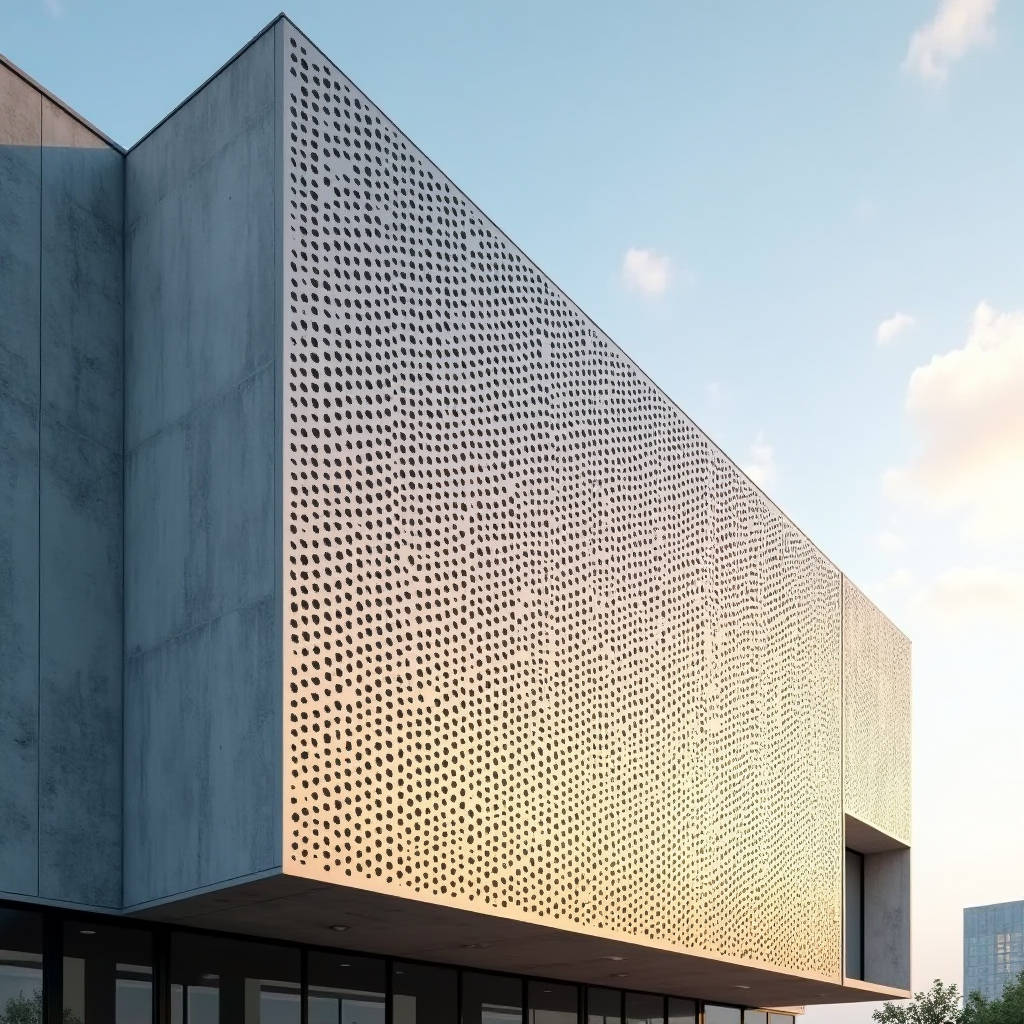
When a facade spec calls for shading, privacy, or controlled daylighting, the aluminum perforated metal screen sheet is often the first material a curtain wall engineer reaches for. But the real engineering question is rarely about the hole pattern. It is about how that perforated sheet behaves under wind load, how it is fixed to the backup structure, and whether the coating will outlast the building envelope it is meant to protect. Too many projects treat perforated aluminum as a decorative afterthought, only to discover mid-installation that the panel lacks the stiffness for its span or that the open area ratio creates acoustic and thermal surprises. This article walks through the load paths, fabrication tolerances, coating systems, and installation economics that determine whether an aluminum perforated metal screen sheet performs as a genuine structural rainscreen or simply becomes a maintenance liability.
Why Perforation Changes the Structural Conversation
Punching holes into a solid aluminium sheet does more than change its appearance. It removes material, which lowers stiffness and raises the stress concentration around every hole edge. A 2.0 mm solid aluminium panel with a 40 percent open area can lose roughly a third of its flexural rigidity compared with the same sheet unperforated. That reduction is not a dealbreaker, but it forces the design team to re-check span tables and deflection limits that were developed for solid cladding.
For an aluminum perforated metal screen sheet used as a rainscreen, the governing load is usually wind. The perforations allow air to pass through, which actually reduces the net pressure coefficient on the panel compared with a fully sealed surface. However, the open area also means the panel must be evaluated for local buckling and for flutter at the unsupported edges. ASTM E330, the standard test method for structural performance of exterior walls, remains the reference for verifying that a perforated panel and its framing meet the specified design pressure.
Engineers should also remember that perforation reduces the effective section modulus at the hole rows. In practice, this means the maximum unsupported span for a given thickness and open area should be pulled back. A common field rule is to reduce the allowable span by 10 to 15 percent when the open area exceeds 30 percent, all else being equal.
Alloy and Temper Selection for Perforated Screens
The alloy choice for an aluminum perforated metal screen sheet is not a marketing detail. It drives corrosion resistance, weldability, and cost. The three alloys that dominate architectural perforated work are 3003, 5052, and 6061, and each earns its place for different reasons.
| Alloy | Typical Temper | Yield Strength (MPa) | Corrosion Resistance | Best Use Case |
|---|---|---|---|---|
| 3003 | H14 | 145 | Good | Decorative screens, signage, low-rise rainscreens |
| 5052 | H32 | 193 | Excellent in marine air | Coastal facades, high humidity environments |
| 6061 | T6 | 276 | Good when coated | Structural framing, load-bearing screen members |
For most curtain wall screens, 5052-H32 is the sensible default because it balances strength with salt-air resistance. 3003 is cheaper and easier to form, which suits large decorative panels where wind loads are modest. 6061-T6 appears when the perforated sheet is load-bearing, such as a balustrade infill or a structural screen that carries its own framing.
Coating Systems That Survive the Weathering Cycle
The coating on an aluminum perforated metal screen sheet is what separates a 10-year facade from a 30-year one. Perforated panels are exposed on both faces, so the coating must protect the cut edges of every hole. Those edges are the first place corrosion starts when the coating is thin or poorly applied.
Two coating families dominate the market. Powder coating is fast, economical, and offers a wide color range, but it is generally rated for about 10 to 15 years of exterior service depending on the resin. PVDF (polyvinylidene fluoride) finishes, applied at a dry film thickness of roughly 25 to 30 microns, carry a 20 to 25 year warranty from reputable coil coaters and hold color and gloss far better under UV exposure. AAMA 2605 is the specification that defines the highest-performance exterior organic coatings, and any PVDF system specified for a perforated screen should meet it.
For coastal projects, the cut edges of the perforations deserve special attention. Specifying a PVDF system with a full edge treatment, or specifying anodized aluminum with a heavy coating weight, reduces the risk of edge creep corrosion. Anodizing at 18 to 20 microns is a premium option that avoids the organic coating entirely and is popular for interior screens and for exteriors where a metallic aesthetic is required.
Open Area, Light, and Sound: The Performance Trade-offs
The open area ratio of an aluminum perforated metal screen sheet is the single most important specification for shading and acoustic performance. A 40 percent open area blocks roughly 60 percent of direct sunlight while still allowing ventilation, which is why it is a workhorse for sunscreens. But the same panel lets more sound pass than a 20 percent open area panel, so acoustic separation and daylighting pull in opposite directions.
For a privacy screen on a balcony or a partition, a lower open area in the 20 to 30 percent range is typical. For a solar shading louver on a south-facing glass wall, 40 to 50 percent open area is common. The hole shape matters too. Round holes in a staggered pattern are the most common because they are cheap to punch and predictable in strength. Square and slotted holes offer more directional shading but concentrate stress at the corners and require thicker material for the same span.
Sound attenuation is worth a caution. A perforated panel alone is a poor acoustic barrier. If the screen is meant to reduce noise, it must be paired with an acoustic backing layer such as a mineral wool blanket or a perforated liner with a cavity. The open area ratio and the hole diameter interact with the backing to determine the absorption coefficient, and this is a calculation best done with measured data rather than assumptions.
Installation Economics and Fixing Strategies
The installed cost of an aluminum perforated metal screen sheet is dominated by the fixing system and the labor to align panels, not by the raw material. A simple through-fastened screen with exposed screws is the cheapest route but leaves visible fixings that can rust if the coating is scratched. A concealed clip system or a cassette-style panel with a hidden fixing costs more per square meter but delivers a cleaner aesthetic and a more weathertight envelope.
| Fixing Method | Relative Installed Cost | Appearance | Best For |
|---|---|---|---|
| Through-fastened with exposed screws | 1.0x (baseline) | Visible fixings | Industrial screens, budget projects |
| Concealed clip system | 1.35x | Clean, no visible fixings | Architectural rainscreens |
| Cassette panel with hidden fixing | 1.55x | Seamless, premium | High-end facades, large-format panels |
For large-format panels, thermal movement becomes a real issue. Aluminium expands and contracts with temperature, and a 3.0 mm panel spanning 3 meters can move several millimeters between a cold winter night and a hot summer afternoon. The fixing system must allow this movement without transferring stress to the panel or the backup structure. Slotted holes and sliding clips are standard solutions, and the design should follow the guidance in the AAMA's curtain wall design manuals for accommodating thermal expansion.
Fabrication Tolerances and Quality Control
Perforation is a mechanical process, and it introduces tolerances that a solid sheet does not have. Hole diameter, hole spacing, and the stagger pattern all vary slightly across the sheet, and when panels are installed side by side, even a 0.5 mm variation in hole position becomes visible as a misaligned pattern. Fabricators should hold hole position to within 0.5 mm and hole diameter to within 0.1 mm for architectural-grade work.
Deburring is another quality point that is easy to overlook. Punching leaves a burr on the exit side of the hole, and if it is not removed, it will damage the coating during handling and create a corrosion site. A good fabricator deburrs both faces and applies the coating after perforation so that the cut edges are protected. This is a key reason to buy factory-direct from a supplier that controls the whole process rather than punching holes into pre-coated sheet.
When sourcing, a reliable reference point is a manufacturer such as Futeng®, which can supply 3003, 5052, and 6061 perforated sheets with anodizing, powder coating, or PVDF finishes and hold the fabrication tolerances that architectural work demands. Specifying the alloy, temper, open area, hole pattern, and coating together in one document removes most of the ambiguity that causes field problems.
Practical Guidance for the Design Team
Start the design by fixing the open area ratio and the hole geometry, because those drive everything downstream. Then verify the wind load using the local design pressure and check the panel span against the reduced stiffness from perforation. Specify the alloy and temper based on the environment, and choose PVDF per AAMA 2605 for exterior screens where longevity matters. Confirm with the fabricator that deburring and post-perforation coating are part of the process, and select a fixing system that accommodates thermal movement. If the screen must also manage sound, add an acoustic backing and verify the absorption with measured data rather than assumptions.
An aluminum perforated metal screen sheet is a versatile and durable facade element when the load path, coating, and fixing are engineered rather than assumed. Get those three right, and the screen will shade, ventilate, and protect for decades. Get them wrong, and the panel will flutter, corrode, or fail at the fixings long before the building does.