Why Acoustic Backing Makes or Breaks Perforated Aluminium Ceiling Panel NRC Over 15 Years
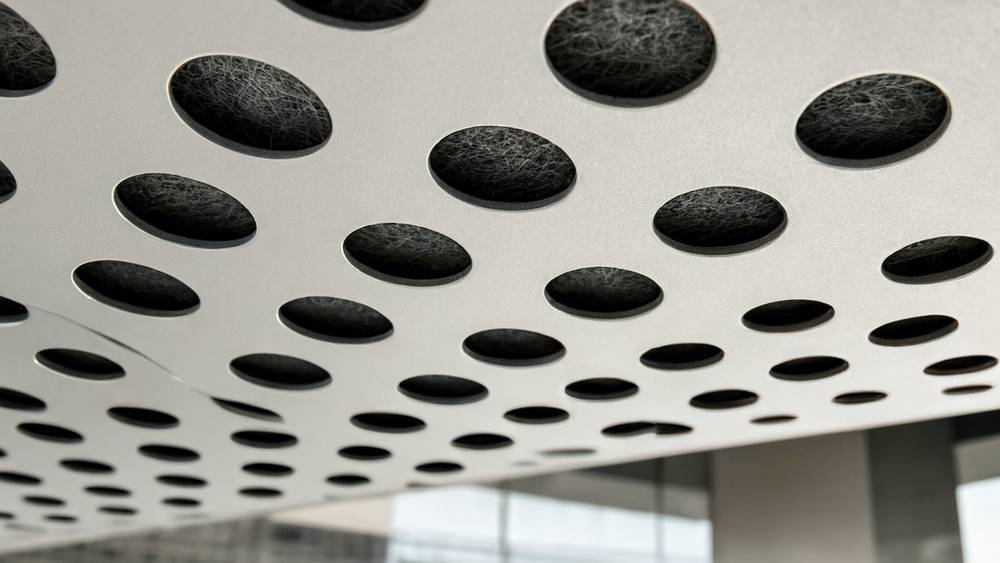
When specifying a perforated aluminium ceiling panel system, the conversation almost always starts with pattern, finish, and price. What rarely gets adequate attention during the design development phase is the acoustic fleece or backing material laminated behind those perforations. Yet this single component determines whether a 0.80 NRC ceiling actually performs at 0.80 in the field, or whether it degrades to 0.55 within three years due to dust loading, moisture absorption, or outright delamination. The gap between laboratory-tested acoustic performance and real-world durability is wider than most project teams realise, and it almost always traces back to the backing specification.
This article examines the engineering trade-offs behind acoustic backing materials used in perforated aluminium ceiling panels. Rather than rehashing general perforation geometry theory, we focus on what happens after the holes are punched: the selection of non-woven polyester fleece, glass fibre tissue, or micro-perforated foil backers, how each interacts with NRC and Dn,w test results, and what actually holds up across a 15-year building lifecycle in airports, metro stations, and open-plan offices.
Why the Backing Dictates Real Acoustic Performance
A perforated aluminium ceiling panel operates on Helmholtz resonator principles. The perforated face sheet acts as the neck, and the plenum cavity behind it forms the volume. Sound energy enters through the holes, and the air mass within each perforation vibrates against the spring effect of the cavity air. Without a resistive layer, this system is narrowly tuned and reflects mid-to-high frequencies rather than absorbing them. The backing introduces flow resistivity, converting kinetic energy in the oscillating air into heat through viscous friction.
The physics is well-established. What changes from project to project is the resistive layer material. Three dominant options exist in the global supply chain for perforated aluminium ceiling panel systems:
- Non-woven polyester fleece (PET): Thermally bonded, typically 80-200 g/m², available in black or white. This is the workhorse material across most commercial interiors.
- Glass fibre tissue: Thin, dense, typically 30-60 g/m², often specified where fire performance is the overriding concern.
- Micro-perforated aluminium foil: A secondary perforated membrane with sub-millimetre holes, creating a purely metallic resistive layer with zero organic content.
Each material shifts the acoustic absorption curve differently. A 1.0 mm thick PET fleece at 120 g/m² might deliver NRC 0.80 with a 2.5 mm perforation pattern at 22% open area. Swap to a 40 g/m² glass tissue and the same panel might drop to NRC 0.65 because the flow resistivity differs. These are not interchangeable without re-tuning the entire panel assembly.
NRC Ratings and the Laboratory-to-Site Performance Gap
The Noise Reduction Coefficient (NRC) reported on product datasheets comes from ASTM C423 or ISO 354 reverberation room tests. A perforated aluminium ceiling panel with acoustic fleece tested in an empty 200 m³ reverberation chamber with a Type E-400 mounting (400 mm plenum) can comfortably achieve NRC 0.75-0.85. Manufacturers publish these numbers because they represent the ceiling under ideal conditions.
Field conditions introduce variables that the laboratory deliberately excludes. Dust accumulation on the fleece surface progressively clogs the fibrous structure, reducing flow resistivity and shifting absorption toward lower frequencies while degrading overall NRC. Research published by the ISO 354 working groups indicates that particulate loading of 2-5 g/m² on acoustic fleece can reduce NRC by 0.10-0.15. In a railway station ceiling with diesel particulate exposure, this loading accumulates within 18-24 months.
Moisture is the second field variable. Polyester fleece is hydrophobic in theory but can wick condensation in high-humidity plenums. Glass fibre tissue, if the binder content is below 8%, can absorb moisture and sag. Neither problem appears in a 23°C, 50% RH laboratory. A study on long-term ceiling performance in humid subtropical climates documented NRC degradation of 0.20-0.25 in glass-backed panels over five years, while PET-backed panels in the same environment lost 0.08-0.12.
For projects where acoustic longevity is contractually specified, the backing material specification needs to move beyond "acoustic fleece to achieve NRC 0.75" and into material-specific parameters: fibre type, areal weight, binder chemistry, and attachment method. Manufacturers such as Futeng® have developed project-specific fleece bonding processes that address these durability concerns at the lamination stage, but the specifier must know to ask for the data.
Fire Performance and the Backing Material Conflict
Here is where specification gets genuinely difficult. The aluminium face sheet is non-combustible, classified A1 under EN 13501-1 or Class A under ASTM E84. The acoustic backing is not.
Polyester fleece is an organic polymer. Standard PET melts at approximately 260°C and burns. Fire-retardant (FR) grades incorporate phosphorus-based or halogenated additives that improve reaction-to-fire classification but introduce long-term stability questions. Some FR additives are hygroscopic, accelerating moisture uptake in service. Others can leach under condensation, leaving the fleece with diminished fire performance after years of humidity cycling.
Glass fibre tissue achieves A2-s1,d0 under EN 13501-1 when properly formulated. This makes it the default choice for perforated aluminium ceiling panel installations in public assembly spaces, transport hubs, and healthcare facilities where smoke development (the "s1" rating) and flaming droplet (the "d0" rating) classifications are non-negotiable. The trade-off is acoustic performance per millimetre of thickness; glass tissue at equivalent NRC is typically thinner but requires more precise perforation tuning.
The following table summarises the key performance trade-offs across the three backing material families:
| Parameter | PET Fleece (120 g/m²) | Glass Fibre Tissue (50 g/m²) | Micro-Perforated Aluminium Foil |
|---|---|---|---|
| Typical NRC (E-400 mount) | 0.75-0.85 | 0.60-0.75 | 0.55-0.70 |
| EN 13501-1 Classification | B-s2,d0 (FR grade) | A2-s1,d0 | A1 (fully metallic) |
| Moisture Resistance | Good (hydrophobic) | Moderate (binder-dependent) | Excellent (non-absorbent) |
| Dust Sensitivity (NRC loss at 5 g/m² loading) | 0.08-0.12 | 0.12-0.18 | 0.03-0.06 |
| Long-Term Delamination Risk | Low (thermally bonded) | Moderate (adhesive-dependent) | None (mechanical or welded) |
| Relative Cost Index | 1.0 (baseline) | 1.3-1.6 | 2.0-2.8 |
| Weight Addition to Panel | 0.12 kg/m² | 0.05 kg/m² | 0.3-0.5 kg/m² |
This table exposes the central tension: the safest fire classification (all-metallic) delivers the weakest broadband absorption, while the best acoustic performer (PET) carries organic content into the ceiling plenum. There is no single "best" backing. There is only the backing that aligns with the project's fire strategy, acoustic specification, and maintenance regime.
Delamination: The Failure Mode Nobody Discusses Until It Happens
Acoustic backing is attached to the rear face of a perforated aluminium ceiling panel through one of three methods: adhesive lamination, thermal bonding, or mechanical retention. Adhesive lamination using solvent-based or hot-melt adhesives remains the most common in high-volume production. It is also the most failure-prone.
The failure sequence is well-known among façade forensics consultants but rarely documented in product literature. Plenum temperatures in buildings with curtain wall facades can cycle between 5°C (winter night, heating off) and 45°C (summer afternoon, solar gain through the façade transmitted into the plenum). Over a 24-hour cycle, the aluminium panel and the fleece expand at different rates. The differential thermal expansion between aluminium (approximately 23 × 10⁻⁶ /K) and polyester fleece (approximately 50-80 × 10⁻⁶ /K) generates shear stress at the bond line.
After 8,000-12,000 thermal cycles (roughly 22-33 years of daily cycling in a temperate climate, fewer in extreme climates), adhesive bond strength can degrade by 40-60%. The first visible sign is sagging fleece visible through the perforations from below. The acoustic consequence is unpredictable: sometimes NRC drops, sometimes it shifts frequency, sometimes the loose fleece vibrates against the panel and creates a secondary noise source.
Specifiers can mitigate this risk through several measures. Thermal bonding eliminates adhesives entirely by fusing the fleece fibres to themselves and partially embedding them into the aluminium surface texture. This requires a slightly roughened rear face on the panel, which competent manufacturers can achieve through specific pre-treatment before powder coating. Mechanical retention using aluminium clamping strips at panel edges adds cost and weight but provides redundancy if the bond line fails. For transport infrastructure projects with 30-50 year design lives, mechanical retention is increasingly specified as mandatory by government asset owners.
Hygiene and the Rise of Non-Porous Backing
Healthcare and food processing facilities introduce a requirement that conflicts directly with acoustic fleece: cleanability. A fibrous PET or glass backing material in a hospital ceiling plenum accumulates dust, supports microbial growth if condensation occurs, and cannot be wiped down or sterilised. The ISO 14644 cleanroom classification framework and hospital infection control protocols increasingly mandate non-porous ceiling surfaces in critical areas.
This is driving adoption of micro-perforated aluminium foil backers. By using a secondary aluminium sheet with laser-drilled perforations in the 0.3-0.5 mm range, manufacturers create a resistive layer that is fully metallic, non-porous, washable, and non-combustible. The acoustic trade-off is real: micro-perforated foil absorbers typically peak in the 500-1000 Hz range and offer less broadband absorption than PET fleece. However, in spaces where speech intelligibility is the primary acoustic concern (consultation rooms, pharmacies, clean corridors), this narrower absorption band is often sufficient.
The cost premium for micro-perforated foil backing is substantial, typically 2.0-2.8 times the cost of PET fleece. This reflects the additional aluminium material, the slower laser perforation process, and the handling complexity of bonding two perforated sheets with precise hole alignment. For budget-sensitive projects, a hybrid approach is emerging: PET fleece in general areas, micro-perforated foil in hygiene-critical zones, both using the same face perforation pattern for visual continuity.
Specifying Backing for Plenum Conditions
The ceiling plenum is not a benign environment. It contains HVAC ductwork, electrical conduits, fire sprinkler piping, and structural elements. Air movement within the plenum can be significant, particularly in return-air plenum designs where the entire ceiling cavity functions as an air return path. Air velocities of 1-2 m/s through the plenum are common; across a perforated aluminium ceiling panel with acoustic fleece, this airflow can carry particulates into the fibrous backing.
Return-air plenum designs warrant specific backing considerations. The fleece acts as a filter, trapping dust that would otherwise enter the HVAC system. While this might sound beneficial, it accelerates the NRC degradation timeline described earlier. Some projects address this by specifying a sacrificial pre-filter layer upstream of the ceiling, but this adds maintenance complexity. An alternative is to specify glass fibre tissue with a denser surface scrim that resists particulate penetration while maintaining acoustic transparency.
Plenum access frequency also matters. Lay-in ceiling systems on standard 15/16-inch T-bar grids, as referenced by manufacturers working within the ASTM C635 framework, allow individual panel removal for plenum access. Each removal and reinstallation cycle stresses the panel edges and, if the backing extends to the panel perimeter, risks delamination initiation at the edges. Hook-on and clip-in systems reduce access frequency but make each access event more disruptive. Specifying a 5-10 mm unbacked margin at panel edges preserves the bond line during handling without significantly affecting overall acoustic performance.
Manufacturing Quality Control Beyond the Datasheet
Two perforated aluminium ceiling panel assemblies with identical specifications on paper can perform very differently depending on manufacturing execution. The fleece lamination process involves temperature, pressure, and dwell time parameters that are not captured on typical product datasheets. Insufficient lamination temperature produces a weak bond that passes initial inspection but fails under thermal cycling. Excessive temperature can melt PET fibres, reducing porosity and altering flow resistivity.
Procurement teams can request three quality documentation items that go beyond standard certificates:
- Peel strength test reports per ASTM D903: Measures the force required to separate the fleece from the aluminium substrate. Values above 2.5 N/cm (for PET on aluminium) indicate adequate bond strength. Anything below 1.5 N/cm warrants rejection or additional sampling.
- Flow resistivity measurement per ISO 9053: The fundamental acoustic parameter of the backing material, expressed in Pa·s/m². This number feeds directly into impedance tube predictions and transfer matrix models. A tolerance band of ±15% on the specified flow resistivity should be contractually defined.
- Accelerated ageing test protocol: 500 hours of thermal cycling between -10°C and +60°C followed by re-measurement of peel strength and flow resistivity. This provides an early indication of long-term bond durability and is particularly relevant for projects in climates with wide diurnal temperature swings.
Suppliers with in-house acoustic testing capability, such as impedance tube facilities operating under ISO 10534-2, can provide batch-level flow resistivity data rather than relying solely on type-test certificates from external laboratories. This level of quality control is not universal across the global supply chain, but it separates manufacturers who understand acoustics from those who simply punch holes and glue fabric.
Maintenance Realities Over the Building Lifecycle
Facility managers inherit the ceiling specification decisions made during design. A perforated aluminium ceiling panel with PET fleece in an airport departures hall will accumulate visible dust around the perforations within 3-5 years. The cleaning protocol matters: aggressive vacuum cleaning can pull the fleece away from the panel rear; wet cleaning is impossible because it saturates the fleece.
The practical maintenance options are limited. Dry vacuuming with low suction and a soft brush attachment is the least damaging approach, but it cannot restore NRC to original values once particulate loading exceeds approximately 10 g/m². At that point, panel replacement is the only path back to specified acoustic performance. This reality argues for specifying thicker fleece (150-200 g/m² rather than 80-120 g/m²) in high-dust environments, as the additional fibre volume provides more capacity to accommodate particulate loading before NRC degradation becomes unacceptable.
For glass fibre tissue backings, the maintenance picture is different. Glass tissue is more fragile under mechanical contact; vacuum cleaning can tear the tissue if the nozzle contacts the surface. The recommended approach is compressed air cleaning from the plenum side, which is only feasible if plenum access exists and the ceiling system is not a sealed pressure plenum. This constraint should be discussed with the mechanical services engineer during design coordination.
Specification Language That Actually Protects the Project
The weakest link in most ceiling specifications is the acoustic backing clause. A typical performance specification reads: "Perforated aluminium ceiling panel to achieve NRC 0.75 when tested in accordance with ASTM C423, Mounting E-400." This language is silent on backing material, attachment method, durability, and fire classification. It invites the contractor to supply the cheapest assembly that hits the NRC number in a laboratory test, with no assurance of field longevity.
A more robust specification approach addresses the backing as a distinct sub-component with its own performance requirements:
The acoustic backing shall be thermally bonded non-woven polyester fleece, minimum areal weight 120 g/m², black, with flow resistivity of 8,000-15,000 Pa·s/m² when tested in accordance with ISO 9053. Peel strength between fleece and aluminium substrate shall exceed 2.0 N/cm when tested per ASTM D903 after 500 thermal cycles between -10°C and +60°C. Fire classification of the complete panel assembly including backing shall be minimum B-s2,d0 per EN 13501-1.
This language gives the contractor clear parameters, gives the manufacturer clear production targets, and gives the client a basis for rejecting non-compliant substitutions. It also signals to the supply chain that this project team understands the difference between a datasheet NRC and a ceiling that still performs after a decade of thermal cycling and dust exposure.
The acoustic backing behind a perforated aluminium ceiling panel is not a commodity accessory. It is the engineered component that converts a perforated metal sheet into a durable acoustic absorber. Getting it right requires moving past NRC numbers into material chemistry, bond mechanics, fire compatibility, and maintenance planning. The projects that do this produce ceilings that sound as good in year ten as they did on commissioning day. The ones that do not will be replacing panels long before the building's next refurbishment cycle.