What 0 7 Mil Polyester Coatings Cost You on Dark Metal Siding for House Facades
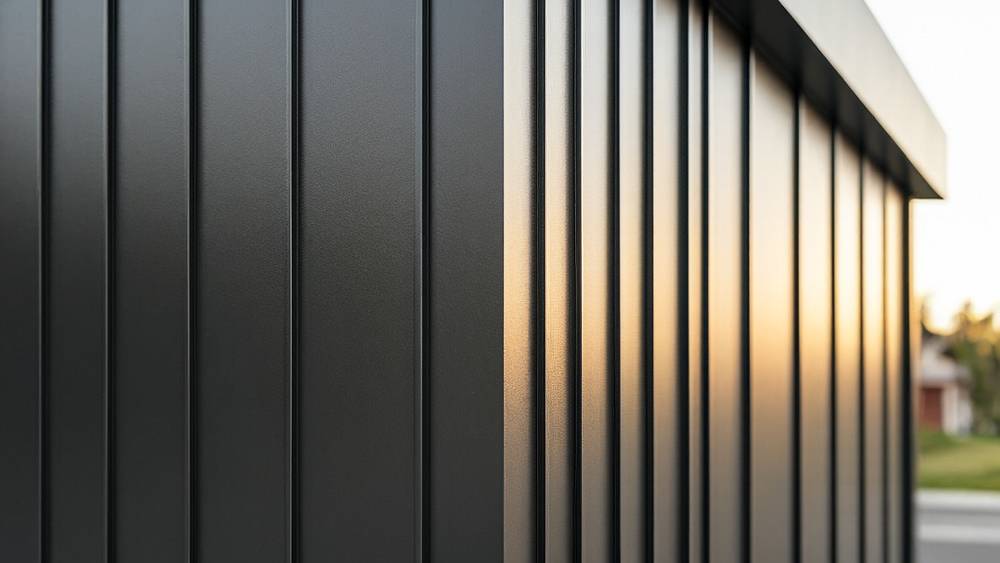
Steel siding now accounts for roughly 18% of all residential exterior cladding installations across North America, yet a quiet but persistent problem keeps surfacing on job sites from Minnesota to Texas: premature coating failure on panels that were supposed to last 30 years. When a general contractor specifies metal siding for house projects, the conversation almost always pivots to gauge thickness and panel profile. But the real variable determining whether that facade still looks acceptable after five winters has less to do with the steel substrate and everything to do with what sits on top of it. This article examines the coating technologies that separate architectural-grade metal siding for house applications from agricultural cladding, with a focus on the specific warranty structures, film thickness tolerances, and accelerated weathering benchmarks that procurement managers should be auditing before signing a purchase order.
The Coating Gap Nobody Talks About
Walk through any suburban subdivision built after 2018 and you will see metal siding for house everywhere, board and batten profiles in charcoal and matte black, horizontal lap panels in greige and forest green. From 50 feet away, the walls look identical. The difference emerges around year three or four. Some panels start to chalk, losing gloss in uneven patches where morning sun hits hardest. Others develop micro-crazing, those hairline cracks in the coating layer that trap moisture and eventually lead to rust blooms bleeding through the paint film.
The root cause is usually not the steel. Most residential metal siding uses G90 hot-dipped galvanized substrate or Galvalume AZ50, both of which provide adequate corrosion resistance when properly coated. The failure sits in the organic coating system, specifically in the resin chemistry and the dry film thickness that was specified or, more commonly, not specified at all. A significant portion of the residential metal siding market runs on polyester coatings with a nominal DFT of 0.7 to 0.9 mils. That is roughly half the thickness that architectural specifiers demand for commercial curtain wall components under AAMA 2605.
Polyester, SMP, PVDF: Three Resin Systems With Three Different Lifespans
Residential metal siding coatings fall into three distinct categories. Standard polyester (PE) dominates the entry-level segment. It costs less, applies easily, and looks fine on day one. Its weakness is ultraviolet resistance. The ester bonds in standard polyester break down under sustained UV exposure, causing gloss fade rates that can exceed 50% within three to five years in high-sun regions like Arizona, Colorado, or Southern California.
Silicone-modified polyester (SMP) represents the mid-tier option. By incorporating silicone intermediates into the polyester backbone, SMP coatings achieve better gloss retention and improved chalk resistance. Most SMP systems carry 20 to 30-year film integrity warranties, though gloss retention warranties typically cap at 15 years. For metal siding for house applications where the owner expects a low-maintenance exterior for two decades, SMP lands in a practical sweet spot between cost and durability.
Polyvinylidene fluoride (PVDF), commonly referred to by the trade name Kynar 500®, occupies the top tier. PVDF coatings rely on a fluoropolymer resin that is chemically inert under UV radiation. The carbon-fluorine bond is simply too strong for UV photons to break. This is why architectural PVDF coatings routinely carry 30-year film integrity and 20-year color retention warranties. They also cost roughly two to three times more than standard polyester on a per-square-foot basis. But for coastal metal siding for house installations or projects above 4,000 feet of elevation where UV intensity jumps by roughly 10% per 1,000 feet, the math tilts decisively toward PVDF.
Warranty Structure as a Procurement Filter
Procurement managers evaluating metal siding for house specifications should treat coating warranties not as marketing documents but as technical data sheets with legal teeth. The critical variables inside any coating warranty include film integrity duration, color retention duration, chalking rating thresholds, and the specific ASTM test methods referenced.
A warranty that promises "30-year film integrity" but only "10-year color retention" signals that the coating will not peel or crack for three decades but will fade noticeably after a decade. Whether that matters depends on the project context. For a spec home being sold immediately, it does not. For a custom residence where the homeowner plans to stay 20 years, it absolutely does.
The warranty structure also reveals whether the coating manufacturer or the panel fabricator bears financial liability. Some warranties cover only raw coating material cost, not labor for removal and replacement. Others are prorated, meaning the payout shrinks each year. A non-prorated, labor-inclusive warranty from a major coating supplier like PPG or Sherwin-Williams carries significantly more weight than a fabricator-issued guarantee that caps liability at product replacement value.
"We have seen projects where the coating warranty looked identical on paper but one excluded labor after year five and the other covered full replacement through year 20. That difference is worth roughly $4 to $7 per square foot in potential exposure."
Dry Film Thickness: The Number That Predicts Performance
If there is one number to pull from a coating specification sheet and check against incoming material, it is dry film thickness measured in mils. Standard polyester on residential metal siding often arrives at 0.7 to 0.9 mils DFT. SMP systems typically run 0.9 to 1.2 mils. Architectural PVDF under AAMA 2605 requires a minimum of 1.2 mils DFT for a two-coat system and 1.5 to 2.0 mils for a three-coat system that includes a barrier primer.
These numbers matter because DFT directly correlates with the coating's ability to bridge surface irregularities, resist mechanical abrasion during installation, and provide sufficient pigment volume to maintain color saturation over decades. A 0.7-mil polyester coating has roughly 30% less hiding power than a 1.0-mil SMP, which means substrate imperfections telegraph through more readily. On dark colors like charcoal or navy, where surface temperature can reach 160°F under direct summer sun, thin coatings also experience accelerated thermal degradation.
Fabricators like Futeng® that supply architectural-grade solid aluminium panels for commercial facades routinely ship with PVDF DFT at 1.5 mils or above, backed by batch-level quality control records. Residential metal siding buyers should demand the same documentation discipline: request a coating DFT report for the specific batch, not a generic product data sheet.
Accelerated Weathering Benchmarks: What the Lab Tests Actually Measure
Coating performance claims are validated through accelerated weathering tests that compress years of outdoor exposure into weeks or months of laboratory cycling. The two benchmarks that matter most for metal siding for house coatings are ASTM G154 for UV/condensation cycling and ASTM B117 for salt spray corrosion resistance.
ASTM G154 uses fluorescent UV lamps to simulate sunlight and a condensation cycle to mimic dew and rain. A typical 5,000-hour G154 test correlates roughly with five to eight years of south-facing Florida exposure, depending on the specific cycle parameters. Coatings that maintain over 50% gloss retention after 5,000 hours of G154 testing are generally considered suitable for residential use. PVDF systems often exceed 90% retention at the same interval.
ASTM B117 subjects coated panels to a continuous 5% salt fog at 95°F. This test is critical for metal siding for house within five miles of saltwater coastlines, where airborne chloride deposition rates can reach 10 to 30 milligrams per square meter per day. A coating that shows no blistering or creep from scribe beyond 2mm after 1,000 hours of B117 exposure has passed the minimum threshold for coastal durability. PVDF plus an epoxy or urethane primer routinely achieves 3,000-plus hours with minimal scribe creep.
| Coating Type | Typical DFT (mils) | ASTM G154 Gloss Retention (5,000 hrs) | ASTM B117 Scribe Creep (1,000 hrs) | Typical Warranty (Film/Color) | Relative Cost per sq ft |
|---|---|---|---|---|---|
| Standard Polyester (PE) | 0.7 – 0.9 | 30% – 50% | 3 – 6 mm | 15 yr / 5 yr | $0.30 – $0.50 |
| Silicone-Modified Polyester (SMP) | 0.9 – 1.2 | 50% – 70% | 2 – 4 mm | 30 yr / 15 yr | $0.50 – $0.80 |
| PVDF (Kynar 500®) 2-Coat | 1.2 – 1.5 | 85% – 95% | < 2 mm | 30 yr / 20 yr | $1.00 – $1.50 |
| PVDF (Kynar 500®) 3-Coat | 1.5 – 2.0 | 90% – 98% | < 1 mm | 35 yr / 25 yr | $1.30 – $1.80 |
| FEVE (Fluoroethylene Vinyl Ether) | 1.5 – 2.2 | 90% – 97% | < 1 mm | 30 yr / 20 yr | $1.40 – $2.00 |
Color Choice and Heat: The Hidden Accelerant
Dark-colored metal siding for house exteriors have dominated architectural trends since 2020. Matte black, charcoal, and deep bronze account for an estimated 40% of residential metal siding shipments according to industry distribution data. These colors absorb more solar radiation than lighter tones, driving panel surface temperatures 30°F to 50°F higher than ambient air temperature on sunny days.
This thermal load accelerates two degradation mechanisms. First, higher temperatures increase the rate of polymer chain scission in the coating resin, effectively speeding up UV degradation even if UV exposure remains constant. Second, thermal expansion and contraction cycles create mechanical stress at the coating-substrate interface. A 20-foot steel panel with a dark PVDF coating can expand by roughly 0.3 inches between a 20°F winter night and a 160°F summer afternoon surface temperature.
The practical implication is that dark-colored panels demand thicker, more UV-stable coatings than light-colored panels on the same building elevation. A standard polyester coating that performs adequately in white or beige may fail within five years in dark bronze or black. The Metal Building Components Inc. technical library documents this differential and recommends PVDF as the baseline for dark colors in high-sun regions.
Installation Damage: When the Coating Fails Before Day One
Coating performance data from laboratory weathering tests assumes intact film. On real job sites, metal siding panels get scratched during handling, gouged by tool belts, and abraded where panels slide against each other during stacking. Each of these mechanical breaches creates a pathway for moisture to reach the metallic substrate, and the corrosion clock starts ticking before the building is even weathertight.
Installation-related coating damage is not a coating chemistry problem. It is a process problem. The most effective countermeasure is touch-up paint applied immediately and correctly. Most coating manufacturers provide matching touch-up pens or aerosol cans, but the quality of the repair depends on surface preparation. A scratched area that is not cleaned of zinc oxide residue from the galvanized layer will not bond properly with touch-up paint, and the repair will flake off within months.
For metal siding for house projects where panels are site-cut with circular saws, the cut edges create another vulnerability. Factory-coated panels have edge protection from the original coil coating process. Field-cut edges expose bare steel. These edges should be oriented away from prevailing weather where possible, and installers should apply a zinc-rich primer or edge treatment within 24 hours of cutting. The ASTM B117 standard provides the benchmark, but the field reality is that edge corrosion often appears first at field cuts on the leeward side where rain lingers longer.
Substrate Matters: Galvanized vs. Galvalume Under the Coating
The coating gets the attention, but the metallic coating underneath the paint film determines what happens if and when the organic coating is breached. G90 hot-dipped galvanized steel carries 0.90 ounces of zinc per square foot and provides sacrificial protection. When the paint film is scratched, the surrounding zinc corrodes preferentially, protecting the steel from rust-through.
Galvalume, a 55% aluminum-zinc alloy coating designated as AZ50 for residential gauges, provides a different protection mechanism. The aluminum component forms a passive barrier, while the zinc provides sacrificial protection at cut edges. Galvalume generally outperforms G90 in ASTM B117 salt spray testing by a factor of two to three, which makes it the preferred substrate for metal siding for house in coastal environments.
The substrate specification should be explicit in the purchase order. A panel described as "painted steel siding" without a substrate designation could arrive as G40, G60, or G90, and the difference in service life between G40 and G90 is roughly 15 to 20 years under identical coating conditions. The GalvInfo Center publishes detailed corrosion rate data for both coating types across different atmospheric exposure categories.
Regional Climate and Coating Selection Logic
A procurement decision that makes sense for metal siding for house in Phoenix does not necessarily apply in Seattle or Miami. UV intensity, humidity cycling, airborne salinity, and freeze-thaw frequency each stress coating systems differently.
In arid high-UV regions, UV resistance dominates the selection matrix. PVDF's fluoropolymer chemistry provides a clear advantage. In humid subtropical climates, moisture-driven blistering and fungal growth on coating surfaces become the primary failure modes. Here, SMP with anti-microbial additives may perform comparably to PVDF at lower cost. In northern climates with frequent freeze-thaw cycles, coating flexibility matters more than UV resistance. A brittle coating that micro-cracks during thermal cycling will fail regardless of its UV stability.
The American Society of Civil Engineers publishes corrosion zone maps in ASCE 7 that categorize atmospheric corrosivity by geography. Category C3 and above environments, which include most coastal areas and industrial corridors, warrant PVDF or FEVE coatings regardless of building type.
FEVE: The Alternative Fluoropolymer Worth Knowing
While PVDF dominates the North American architectural coating market, fluoroethylene vinyl ether (FEVE) resins represent an alternative fluoropolymer chemistry that has gained significant traction in Asia and Europe. FEVE coatings can achieve comparable weatherability to PVDF with one operational advantage: they are thermosetting rather than thermoplastic, which allows for higher gloss levels and a wider color gamut, including bright reds, yellows, and oranges that are difficult to formulate in PVDF.
For metal siding for house applications where the design calls for high-gloss or vivid color, FEVE may be the only fluoropolymer option. The trade-off is cost. FEVE coatings typically run 10% to 20% above PVDF on a per-square-foot basis, and the applicator base is smaller in North America, which can impact lead times.
Supplier Audit Checklist for Coating Compliance
Procurement managers and specifiers evaluating metal siding suppliers should treat coating compliance as a verifiable technical requirement rather than a trust-based assurance. The following audit points separate suppliers who control coating quality from those who simply pass through whatever their coil coater provides:
- Request batch-specific DFT measurement reports using a calibrated eddy-current gauge per ASTM D7091, not a generic certificate of conformance
- Verify that the coating supplier name and resin type appear on the product data sheet, not just a trade name without chemical disclosure
- Confirm that the warranty document specifies whether labor is included and whether the warranty is prorated or non-prorated
- For coastal projects, request ASTM B117 test reports for the specific coating batch, with scribe creep measurements at 1,000 and 2,000 hours
- Ask for a written touch-up procedure that includes surface preparation steps and compatible primer recommendations
- Check that the supplier maintains inventory segregated by coating batch, enabling traceability from coil to installed panel
These audit steps apply regardless of whether the panel substrate is steel or solid aluminium. The coating quality control discipline is the same. Fabricators with established architectural programs, including Futeng® for solid aluminium cladding systems, typically have these documentation packages ready as standard deliverables rather than special requests.
Making the Coating Decision That Outlasts the Mortgage
The coating on residential metal siding carries a disproportionate share of the building envelope's long-term performance burden. It is the only layer standing between the steel substrate and everything the atmosphere throws at it. Panel gauge, profile geometry, and fastener type all matter, but none of them matter if the coating fails because it was specified for a pole barn and installed on a custom home with south-facing dark-colored walls.
The decision framework is straightforward. Identify the project's dominant environmental stressor: UV, salt, moisture cycling, or thermal range. Match the coating chemistry to that stressor. Specify DFT in the purchase documents, not just the coating type. Verify with batch-level data before panels leave the fabricator. And insist on a warranty that covers labor, not just material, because the coating itself is a small fraction of the total installed cost. The labor to remove and replace failed siding is where the real financial exposure lives.
These principles hold across residential, commercial, and institutional building types. Whether the substrate is steel coil or solid aluminium sheet, coating performance is a function of chemistry, thickness, and quality control. When those three variables are specified and verified, metal siding for house becomes a genuinely low-maintenance facade solution. When they are ignored, the siding becomes a maintenance liability that starts costing money years before anyone expected to write a check.