3 mm Solid Aluminum Panels and the Oil Canning Problem Nobody Specifies Properly
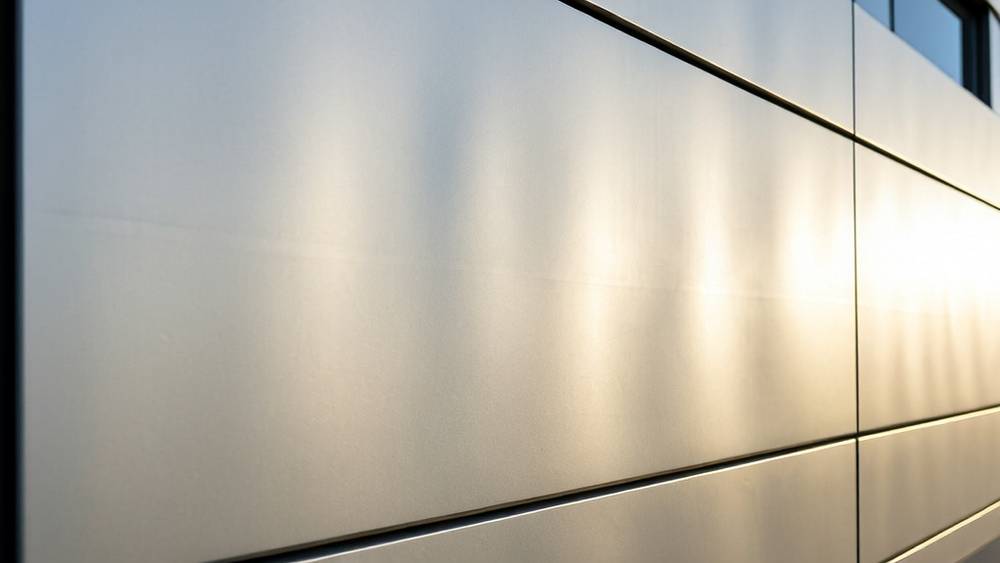
When a commercial facade contractor in Dubai receives a shipment of solid aluminum panels and finds visible ripples across the surface under morning light, the project schedule takes an immediate hit. That waviness, known in the trade as oil canning, remains one of the most persistent quality complaints in architectural metal cladding. It does not stem from impact damage during transit or a failed PVDF coating batch. It originates much earlier — in the flatness tolerances written into the purchase specification, or more often, the absence of them.
Oil canning describes the slight undulation or "pillowing" visible on the surface of flat metal panels under certain lighting conditions. In solid aluminum panels, this phenomenon has a mechanical root: residual stresses introduced during coil rolling, slitting, and leveling interact with panel geometry, stiffener layout, and the fixing method to produce elastic buckling. The Aluminum Association and multiple ASTM workgroups have studied the issue extensively, yet no single international standard defines an enforceable oil canning acceptance criterion for architectural cladding. This gap places the burden squarely on the specifier and the procurement team to establish measurable flatness parameters before production begins.
The problem compounds when panels grow larger. A 2.0 mm thick solid aluminum panel spanning 1,200 mm between stiffeners behaves differently from a 3.0 mm panel at 600 mm spacing. Yet too many project specifications copy generic language — "panels shall be free of oil canning" — which means nothing in a courtroom or on a scaffold. What follows is a technical breakdown of how oil canning originates in solid aluminum panels, how to specify flatness in enforceable terms, and what fabrication decisions genuinely reduce the risk.
What Actually Causes Oil Canning in Solid Aluminum Panels
Oil canning is elastic buckling at the panel level. It does not indicate material failure or compromised structural capacity, but it creates an appearance that architects and building owners find unacceptable. The root cause is differential residual stress across the panel surface combined with insufficient bending stiffness to resist out-of-plane deformation.
When aluminum coil is rolled to final gauge at the mill, the reduction process introduces a complex stress field. The outer fibers of the strip experience different deformation than the center. Even after stretcher leveling — a process that elongates the strip slightly past its yield point to equalize internal stresses — some residual stress remains. When a fabricator shears a blank from that leveled coil, the cut edges release constraint, and the stress field redistributes. The panel may look flat on the shop table, but it now holds latent energy waiting for a trigger: thermal expansion on a hot facade, wind suction pulling outward, or simply the self-weight deflection between supports.
Three factors converge to make oil canning visible:
- Panel aspect ratio and thickness. A thin, wide panel with a large unsupported span has low bending stiffness. The critical buckling load drops rapidly as the width-to-thickness ratio increases. A 2.0 mm panel at 1,500 mm span may exhibit visible waviness at stresses well below yield, while the same panel at 800 mm span stays flat.
- Stiffener design and attachment. Most solid aluminum panels use aluminum stiffeners bonded to the rear face with structural adhesive. The stiffener spacing, profile section, and bond line continuity directly control the panel's resistance to buckling. A poorly bonded stiffener that detaches under thermal cycling leaves an unsupported zone that will oil can.
- Fixing system restraint. Panels fixed with slotted connections that allow thermal movement reduce membrane stress buildup. Panels rigidly fixed on all four edges force thermal expansion into compressive stress, increasing the likelihood of buckling. The Aluminum Association's Aluminum Design Manual provides guidance on thermal movement accommodation, yet projects routinely overlook this in fixing detail design.
The Specification Gap: Why "No Oil Canning" Is Unenforceable
Walk through any major curtain wall specification and you will find language similar to: "Panel surfaces shall be flat and free from oil canning, buckling, or other visual distortions." This reads like quality control but functions as wishful thinking. Without a measurement protocol, an acceptance angle, and defined viewing conditions, the clause collapses under scrutiny.
The metal building industry has attempted to close this gap. The National Association of Architectural Metal Manufacturers (NAAMM) and the Metal Construction Association (MCA) have published white papers and position statements on oil canning in formed metal panels. Their guidance acknowledges that some degree of waviness is inherent in flat metal products and recommends evaluation under specific lighting and distance conditions — typically viewing from 10 feet (3 meters) away, with diffuse daylight, and at an angle no steeper than 45 degrees from the plane of the panel.
Some project teams now reference ASTM E1367, a standard practice for evaluating flatness of steel floor plates, and adapt its straightedge-and-feeler-gauge method to aluminum cladding panels. The adaptation is imperfect — ASTM E1367 targets floor flatness, not visual appearance on vertical facades — but it provides a quantitative baseline. A typical adapted criterion might read: "Under a 1,200 mm straightedge placed at any location on the panel face, the maximum gap shall not exceed 3.0 mm for panels up to 2.0 m² and 4.0 mm for panels over 2.0 m²."
The more robust approach references the German flatness tolerances in DIN EN 485-2 for aluminum sheet and plate. This standard defines maximum deviation from flatness as a function of thickness and width, expressed in millimeters per meter of length. For example, EN 485-2 Table 4 specifies that cold-rolled aluminum sheet in alloy 3003 or 5052 at 2.0 mm thickness and 1,500 mm width shall not deviate more than 0.4% of length for general-purpose flatness, and 0.3% for special flatness. These numbers translate to 4.0 mm and 3.0 mm respectively over a 1,000 mm gauge length — values that provide a genuine contractual benchmark.
Industry guidance from the Metal Construction Association: "Oil canning is not a cause for panel rejection unless it is clearly visible and objectionable under specific viewing conditions agreed upon by all parties prior to fabrication." — MCA White Paper on Oil Canning
Thickness Selection and Stiffener Layout: The Engineering Controls
Fabricators who produce flat solid aluminum panels consistently do not rely on luck. They engineer the panel system to push the critical buckling stress above the maximum service stress the panel will experience. This involves two interrelated decisions: base metal thickness and stiffener spacing.
Panel thickness directly governs bending stiffness, which scales with the cube of thickness. Moving from 2.0 mm to 3.0 mm increases stiffness by a factor of roughly 3.4, assuming the same alloy and temper. This is why 3.0 mm solid aluminum panels rarely exhibit oil canning in standard facade applications, while 2.0 mm panels require careful stiffener engineering. The cost increment for the thicker material — typically 40-50% more raw material by weight — must be weighed against the cost of additional stiffeners, the risk of rework, and the value of a reputation for delivering flat facades.
Stiffener design follows a few practical rules derived from plate buckling theory and shop experience:
- Maximum stiffener spacing. For 2.0 mm thick 3003-H14 panels, keep stiffener center-to-center spacing below 600 mm when the panel dimension perpendicular to the stiffener exceeds 1,000 mm. For 2.5 mm panels, 800 mm spacing is generally safe. For 3.0 mm panels, 1,000 mm spacing works in most conditions. These numbers assume aluminum hat-section stiffeners 30-40 mm deep, properly bonded.
- Stiffener orientation. Run stiffeners parallel to the shorter panel dimension. This reduces the unsupported span in the direction of maximum bending. On panels with aspect ratios near 2:1 or greater, orienting stiffeners the wrong way can triple the effective span.
- Adhesive selection and application. Structural silicone or two-part epoxy adhesives must maintain bond integrity across the full service temperature range, typically -30°C to +80°C for exterior cladding. A discontinuous bond line — one applied in dabs rather than a continuous bead — creates stress concentrations that can initiate local buckling at the unbonded gaps.
- Edge distance. The outermost stiffeners should sit 100-150 mm from the panel edge return. Leaving a wider unsupported edge zone invites rippling along the perimeter, which is often the most visible location on a facade.
Some fabricators, including Futeng®, have adopted pre-stressing techniques during stiffener attachment. By applying a slight camber to the panel before bonding — essentially building in a controlled tension field — the panel arrives at a flatter neutral state once released. This is not standardized across the industry but represents the kind of shop-level expertise that separates consistent suppliers from those who treat oil canning as an unavoidable fact of life.
Alloy Selection and Temper: The Overlooked Variables
Not all aluminum resists oil canning equally. The alloy and temper determine the stress-strain curve, the level of residual stress after leveling, and the response to thermal cycling. The two alloys that dominate architectural solid aluminum panels — 3003 and 5052 — behave differently in flatness-critical applications.
Alloy 3003-H14 is the workhorse. It offers good formability for bending panel returns, accepts PVDF and powder coatings well, and costs less than 5052. However, 3003 has a lower yield strength (approximately 145 MPa in H14 temper) and a lower modulus of elasticity compared to 5052. Under thermal compression, it enters the post-buckling regime at lower stress levels. For panels under 2.0 m² and with moderate stiffener spacing, 3003-H14 performs adequately. For larger panels or those in high-thermal-range climates, the material choice matters.
Alloy 5052-H32 provides higher yield strength (approximately 195 MPa) and better corrosion resistance, particularly in coastal and industrial environments. The higher yield strength means the panel can sustain greater compressive membrane stress before buckling initiates. The trade-off is cost — 5052 typically commands a 15-25% premium over 3003 — and slightly reduced formability, which can affect tight return bends.
The temper designation also matters. H14 and H32 represent strain-hardened conditions with partial annealing. Full-hard tempers like H18 or H38 hold more residual stress and are more prone to oil canning despite their higher strength. Most architectural panel specifications correctly call for H14 or H32, but a procurement team substituting H18 "because it's stronger" will likely worsen the flatness problem they are trying to solve.
| Parameter | 3003-H14 | 5052-H32 | 5005-H14 | Impact on Oil Canning |
|---|---|---|---|---|
| Yield Strength (MPa) | ~145 | ~195 | ~130 | Higher yield = higher buckling resistance |
| Elastic Modulus (GPa) | ~69 | ~70 | ~69 | Negligible difference between alloys |
| Residual Stress Level | Moderate | Moderate-Low | Moderate | Lower residual stress = lower risk |
| Formability (Bend Radius) | 1.0t-1.5t | 1.5t-2.0t | 1.0t-1.5t | Affects edge return quality |
| Corrosion Resistance | Good | Excellent (Marine) | Very Good | Affects long-term surface stability |
| Relative Cost (per kg) | Base | +15-25% | +8-15% | Budget vs. flatness trade-off |
| Recommended Max Panel Size (2.5 mm) | ~2.5 m² | ~4.0 m² | ~2.0 m² | Larger panels need stronger alloy |
Fabrication Sequence: Where Flatness Is Won or Lost
The flatness of a finished solid aluminum panel is determined as much by what happens on the shop floor as by what is written in the specification. A perfectly leveled blank can emerge from the shear with a bow if the shear blade clearance is wrong, if the hold-down pressure is uneven, or if the operator processes the coil in the wrong orientation relative to the rolling direction.
The fabrication sequence that preserves flatness follows a disciplined order:
- Blanking from leveled coil. Use a CNC turret punch or guillotine shear with proper blade clearance (typically 6-8% of material thickness for aluminum). Keep blanks supported on flat tables — never stack blanks on edge or lean them against a wall overnight. The blank should be cut so that the longer panel dimension aligns with the coil rolling direction, as residual stresses are generally more uniform along this axis.
- Edge folding and notching. When the panel edges are folded to form returns, the bending operation introduces new stresses at the fold line. A radius that is too tight — below 1.0 times material thickness for 3003-H14 — can crack the outer fiber and create a visible distortion line that telegraphs to the face. Progressive bending in multiple passes with intermediate stress relief (simply resting the panel flat) produces better results than single-pass forming.
- Stiffener bonding. Apply structural adhesive in a continuous 6-8 mm bead along the full length of the stiffener contact surface. Place the panel face-down on a flat granite or steel surface table — not a wooden bench that may itself be warped. Position stiffeners using a jig that holds them at the designed spacing and applies uniform pressure during curing. Rushed curing with heat lamps can create thermal gradients that lock in warp.
- Post-fabrication inspection. Lay each panel on a certified flat inspection table under diffuse overhead lighting. Run a straightedge at multiple orientations and record gap measurements. Panels exceeding the agreed flatness tolerance should be identified before coating — a rework at this stage costs far less than a rejection on site.
Transportation and Site Handling: Protecting Flatness After the Factory
A panel that leaves the factory perfectly flat can arrive on site with oil canning induced by poor handling. Solid aluminum panels are elastic structures; they can be temporarily deformed by improper stacking and will partially recover, but repeated flexing or sustained bending under stack weight can shift the residual stress field enough to create permanent waviness.
Shipping best practices include:
- Vertical A-frame stillage with padded contact points spaced no more than 1,200 mm apart. Panels should never be shipped flat on a pallet unless individually separated by rigid foam sheets and the stack height is limited to prevent the bottom panels from bearing excessive weight.
- Protective film left in place until after installation. The film does not prevent oil canning, but it protects the coated surface from scratches that draw the eye and make subtle waviness more noticeable.
- On-site storage under cover, in the same orientation as shipping. Panels leaned against a wall at a shallow angle for more than a day will creep toward that angle.
For the installer, the critical moment is the first fixing. A panel offered up to the substructure and forced into plane by tightening fasteners against a misaligned grid will carry that forced deflection as membrane stress. The resulting oil canning may not appear immediately — it might emerge weeks later as the panel undergoes its first thermal cycle. Pre-installation survey of the substructure for flatness (typically ±3 mm over 3 meters per AAMA TIR-A9) is not optional; it is the last checkpoint before the panel takes its final position on the building.
Quantifying Acceptance: Moving from Opinion to Measurement
The single most effective action a project team can take is to replace subjective oil canning language with a measurement protocol. Drawing from the adapted ASTM E1367 approach, the EN 485-2 tolerances, and MCA guidance, a robust specification clause for solid aluminum panels should include:
- Measurement tool. A calibrated straightedge of specified length (1,000 mm or 1,200 mm) and a tapered feeler gauge or digital depth gauge accurate to 0.5 mm.
- Measurement locations. A defined grid of test points — for example, one measurement per 0.5 m² of panel area, distributed across the face. Include specific points near the edges and at mid-span between stiffeners.
- Acceptance limit. A numeric flatness deviation, such as "maximum 3.0 mm gap under a 1,200 mm straightedge placed anywhere on the panel face, measured in any direction."
- Viewing conditions for visual assessment. "Evaluation shall be conducted from a distance of 3 meters, at an angle of 45° to 90° from the panel plane, under diffuse natural daylight or equivalent artificial lighting without direct specular reflection toward the observer."
- Mock-up precedence. "An approved on-site mock-up of minimum 3 panels by 3 panels shall serve as the reference standard for flatness. Panels shall match or exceed the flatness of the approved mock-up."
The mock-up approach is particularly effective because it anchors the specification to a physical reference that both the contractor and architect have seen and approved. If the mock-up shows minor oil canning that the architect accepts, that becomes the enforceable standard. If the mock-up is perfectly flat, subsequent panels must match it.
Referencing recognized standards strengthens the clause legally. ASTM E1367 provides the straightedge methodology. DIN EN 485-2 defines flatness tolerances for aluminum sheet products. The Metal Construction Association publishes technical bulletins on oil canning evaluation. AAMA technical information reports cover installation tolerances for metal curtain wall components. These documents do not replace the project-specific acceptance criteria but provide an industry-recognized foundation.
When Oil Canning Appears Despite Best Efforts
Even with rigorous specification, proper alloy selection, engineered stiffener layouts, and careful handling, some panels may exhibit oil canning after installation. The question becomes: is this a defect requiring replacement, or is it within the range of inherent material behavior?
The answer depends on the contract. If the specification contains a measurable flatness criterion and the panel fails it, replacement is justified. If the specification used the unenforceable "free of oil canning" language, the parties are headed for a dispute. This is not a hypothetical scenario — it plays out regularly on commercial projects worldwide, and the outcome usually depends on which party documented the acceptance criteria before the first panel was fabricated.
For panels that exhibit borderline oil canning — visible under harsh raking light but not under normal diffuse daylight — several remediation approaches exist. Adjusting the fixing to release some edge restraint can reduce compressive membrane stress. Adding an intermediate stiffener retrofitted with adhesive can break up the unsupported span. In some cases, simply waiting through a seasonal thermal cycle allows the panel to settle into a lower-energy state. But these are field fixes, not factory solutions, and they cost multiples of getting the flatness specification right in the first place.
The engineering reality is that solid aluminum panels, like all flat metal products, exist on a spectrum between perfectly planar and visibly wavy. The industry's task is not to eliminate oil canning entirely — that would require infinite stiffness or zero thermal expansion — but to define, measure, and enforce a flatness standard that aligns with the architectural intent and the project budget. The tools exist. The standards, while imperfect, provide a framework. What separates successful projects from troubled ones is whether the team uses those tools before production begins, or only after the panels arrive on site.