White Cladding Panels Why TiO₂ Grade Determines 5 Year vs 25 Year Facade Life
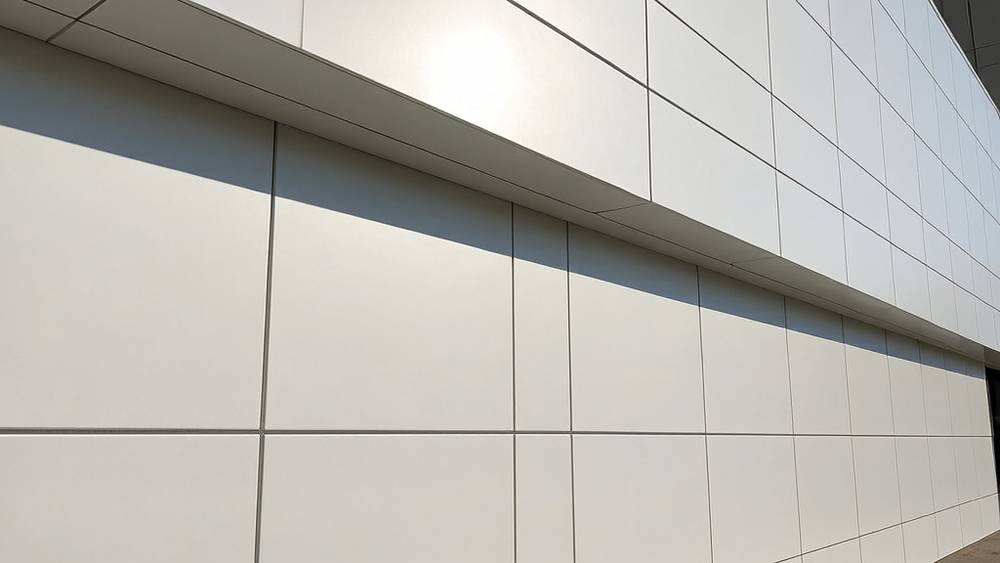
When a commercial facade turns streaky grey within 36 months of installation, the blame rarely falls on the aluminium itself. It falls on the colour. White cladding panels expose every compromise in coating chemistry, every shortcut in pigment selection, and every missed quality-control check at the coater. A dark bronze panel hides resin degradation behind its own depth of tone. A bright white panel has nowhere to hide. For architects and facade contractors specifying solid aluminium sheets for high-visibility building envelopes, understanding why white finishes fail early is not an academic exercise. It is a procurement requirement that separates a five-year warranty claim from a 25-year maintenance cycle.
Why White Finishes Age Differently on Solid Aluminium Cladding Panels
The physics that governs white cladding panels differs fundamentally from darker colours. A 70% PVDF resin system loaded with titanium dioxide (TiO₂) pigment behaves differently under UV radiation than the same resin loaded with carbon black or iron oxide. TiO₂ is photocatalytic. It absorbs UV energy and, in the presence of moisture, generates free radicals that attack the very resin matrix meant to encapsulate it.
This is not a hypothetical concern. ASTM D2244 colour difference testing on white solid aluminium panels exposed in South Florida at 45° South-facing for 36 months routinely shows Delta E values exceeding 3.0 when lower-grade polyester coatings are used. For PVDF coatings meeting AAMA 2605, the same test period typically yields Delta E under 1.5. The difference is not marginal. It is visible from street level.
The second factor is infrared reflectance. White surfaces reflect approximately 80-85% of solar infrared radiation, compared to 25-30% for dark greys. This keeps the aluminium substrate cooler, which sounds beneficial. But it also means the coating experiences sharper thermal cycling between daytime solar load and nighttime radiative cooling. A white panel in Riyadh might swing from 75°C surface temperature at 14:00 to 18°C by 05:00. That 57°C daily delta stresses the coating-substrate bond in ways that mid-tone colours rarely experience.
TiO₂ Pigment Quality and the Chalking Rate Nobody Discusses
Not all titanium dioxide is equal. The architectural coatings industry recognises two primary grades: chloride-process rutile TiO₂ and sulphate-process anatase TiO₂. For exterior-grade white cladding panels, only the former is viable. Rutile TiO₂ offers superior UV stability because its crystal lattice absorbs less UV radiation and its surface treatment (typically alumina, silica, or zirconia encapsulation) suppresses photocatalytic activity.
Sulphate-process anatase TiO₂ costs roughly 30-40% less per kilogram. It also chalks approximately three to five times faster under identical QUV-B 313 accelerated weathering per ASTM G154. A facade contractor who accepts a white solid aluminium panel without verifying the TiO₂ grade specified in the coating formulation is accepting a calculated risk that the supplier has already priced in.
| Coating Parameter | High-Performance PVDF White | Standard Polyester White | Budget Polyester White |
|---|---|---|---|
| TiO₂ Grade | Chloride-process rutile (Al₂O₃/SiO₂ encapsulated) | Mixed rutile, partial encapsulation | Sulphate-process anatase, minimal treatment |
| Resin System | 70% PVDF (Kynar 500® or Hylar 5000®) | Silicone-modified polyester | Linear polyester, no modification |
| Dry Film Thickness | 30-35 μm (AAMA 2605 compliant) | 20-25 μm | 15-20 μm |
| QUV-B 313 Gloss Retention (3000 hrs) | ≥ 85% | 50-65% | 30-45% |
| Delta E After 5 Years Florida Exposure | ≤ 2.0 | 3.5-5.5 | 6.0-10.0+ |
| Expected Service Life Before Chalking | 20-30 years | 8-12 years | 3-6 years |
| Typical Cost Index (per m², relative) | 100 (baseline) | 55-65 | 30-40 |
The cost index column tells a story that procurement teams need to read carefully. A white cladding panel specified with budget polyester at 30-40% of the PVDF baseline price may look identical on day one. By year four, the owner is budgeting for recoating or replacement. The lifecycle cost equation flips decisively.
Gloss Level as a Durability Indicator, Not an Aesthetic Choice
White solid aluminium panels are commonly specified in gloss ranges from 15-20 (matte) to 70-80 (high gloss). The relationship between initial gloss and weathering performance is not linear, and it is not intuitive.
High-gloss white finishes (60-80 GU at 60° geometry per ASTM D523) contain higher resin-to-pigment ratios at the surface. The resin-rich surface layer provides the initial specular reflection. Under UV exposure, this resin layer erodes first. A panel starting at 75 GU might drop to 45 GU in 10 years. That is a 30-GU loss, and it is noticeable as a dull patch against adjacent panels that may have aged differently due to orientation or shading.
Low-gloss matte white panels (15-25 GU) start closer to their "aged" state. Their surface is already micro-roughened by deliberate pigment crowding or matting agents. The UV-driven resin erosion that causes gloss loss in high-gloss panels produces a much smaller absolute change in matte finishes. A 20-GU panel might drop to 14 GU over the same decade. The perceptual difference is negligible.
For large commercial facades using white cladding panels, specifying matte or low-gloss white (20-30 GU) is a risk-management decision disguised as a design choice. It reduces the visibility of differential weathering between south-facing and north-facing elevations, and it narrows the gap between warranty-covered performance and observable reality.
The Dirt Retention Paradox: White Looks Clean Until It Does Not
White architectural surfaces present a maintenance paradox that facade consultants understand but clients often do not. White cladding panels reflect light so effectively that surface dust and atmospheric soiling become more visible than on mid-tone greys, not less. The contrast ratio between the bright white substrate and dark particulate deposits is high.
This matters because the cleaning cycle drives lifecycle cost. A white PVDF-coated solid aluminium facade in an urban environment with moderate rainfall (600-800 mm annually) might require pressure washing every 18-24 months to maintain a uniform appearance. The same building clad in silver metallic might stretch that interval to 36-48 months.
Hydrophilic versus hydrophobic coating formulations add another variable. Some PVDF white coatings are formulated with slight hydrophilicity, encouraging rainwater to sheet across the surface and carry away loose particulates. Others are inherently hydrophobic, causing water to bead and leaving concentrated dirt rings at each evaporation point. Specifying a hydrophilic self-cleaning PVDF formulation for white cladding panels in low-rainfall regions can reduce maintenance frequency by 30-40% over the facade lifecycle.
The American Architectural Manufacturers Association publishes AAMA 613.2, a voluntary specification for self-cleaning organic coatings on architectural aluminium. While not widely adopted, it provides a testing framework that specifiers can reference when evaluating hydrophilic coating claims from suppliers.
Substrate Preparation and the White That Turns Yellow
A white finish that yellows within 12-24 months is almost never a pigment failure. It is a chromate leaching problem.
Solid aluminium sheets require chemical pre-treatment before coating to ensure adhesion and corrosion resistance. The industry standard for architectural applications is a chromium-based conversion coating applied by immersion or spray, producing a yellow-green chromate layer 200-500 mg/m² on the aluminium surface. When the conversion coating is applied too heavily, or when the subsequent primer layer is too thin (below 5 μm dry film thickness), chromate ions migrate into the white topcoat over time.
The result is a faint but measurable yellow shift, typically concentrated at panel edges and fastener penetrations where the chromate layer is thickest. ASTM E313 yellowness index testing can quantify this shift. A Delta YI exceeding 2.0 within two years of installation points directly to inadequate primer barrier performance.
The fix is not in the topcoat. It is in the pre-treatment and primer specification. A two-coat system (primer + colour coat) with a minimum 5-8 μm epoxy or polyurethane primer provides the barrier needed to isolate the chromate layer. Some coaters now offer chrome-free pre-treatment systems based on zirconium or titanium chemistry, eliminating the yellowing risk entirely. These systems comply with the European Union REACH regulations restricting hexavalent chromium compounds.
For projects in jurisdictions aligned with EU environmental standards, or for projects pursuing LEED v4.1 or BREEAM credits, specifying chrome-free pre-treatment on white cladding panels addresses both the technical yellowing risk and the regulatory compliance requirement simultaneously.
Panel Flatness and Optical Distortion on White Facades
White amplifies surface irregularities. A solid aluminium panel with 1.5 mm of oil canning (localised waviness) may be commercially acceptable per ASTM E3301 when coated in dark grey. The exact same panel in bright white will show every wave as a highlight-and-shadow pattern visible from 30 metres.
This optical sensitivity changes the flatness tolerance conversation. The Aluminium Association's Designation System for Aluminium Finishes references flatness tolerances that are colour-agnostic. They do not account for the perceptual difference between dark and light finishes. A prudent specification for white cladding panels adds a subjective flatness inspection under oblique lighting conditions, typically at a 15-20° grazing angle from the panel surface.
Panel thickness is the primary lever for flatness. Moving from 2.0 mm to 3.0 mm solid aluminium reduces oil canning amplitude by approximately 40-50% for a given panel size, simply because the bending stiffness scales with the cube of thickness. For white panels exceeding 1,200 mm in any dimension, 3.0 mm thickness should be the default specification, not an upgrade option.
Welding Marks, Grinding Lines, and White Coating Hiding Power
White coatings have high hiding power. That is both their advantage and a procurement trap.
Solid aluminium cladding panels are often fabricated with welded corners, stiffener attachments, and edge returns. These welds require grinding to achieve a flush surface before coating. A white PVDF topcoat at 30-35 μm dry film thickness will hide the colour difference between the aluminium substrate and the weld filler metal. It will not hide the surface texture difference.
A ground weld that is visually invisible under a dark bronze finish may appear as a subtle texture ghost under white when viewed at low sun angles. The remedy is not thicker coating. It is finer grinding. Specifying a P320 or finer abrasive for final finishing of welded areas before pre-treatment, and requiring a visual inspection under raking light before coating application, addresses the root cause.
Suppliers such as Futeng® that operate integrated fabrication and coating lines can control this grinding-to-coating workflow without the handoff gaps that occur when fabrication and coating are performed at separate facilities. The quality assurance documentation should include pre-coating surface photographs of welded areas for white panels, not just post-coating final inspection reports.
Accelerated Weathering Tests and Their Real-World Limits for White Finishes
QUV-B 313 and Xenon arc accelerated weathering per ASTM G154 and ASTM G155 are the standard tools for predicting coating durability. For white cladding panels, these tests have a specific limitation: they do not reproduce the photocatalytic TiO₂ degradation cycle accurately.
QUV-B 313 uses fluorescent UV lamps with a peak emission at 313 nm, which is more aggressive than natural sunlight below 295 nm. This can over-accelerate resin degradation relative to pigment degradation, producing misleadingly poor results for white PVDF systems and misleadingly good results for some polyester whites that survive short-wavelength UV better than they survive the full-spectrum photocatalytic chalking process.
Xenon arc testing per ASTM G155 with daylight filters provides a closer spectral match to natural sunlight and is the preferred method for evaluating white coatings. However, even Xenon arc cannot reproduce the wet-dry cycling and condensation effects that drive TiO₂ photocatalysis in real exterior conditions.
The most reliable data for white cladding panels comes from South Florida exposure testing at 45° South-facing, per ASTM G7. Ten-year Florida data for a specific white coating formulation is worth more than 5,000 hours of Xenon arc data. Specifiers should request Florida exposure data from coating manufacturers and from panel suppliers who maintain their own exposure racks. If neither party can produce it, the specification is based on extrapolation, not evidence.
Warranty Structure and What White Finishes Reveal About Your Supplier
Coating warranties for architectural aluminium are typically structured as film integrity warranties, not appearance warranties. A PVDF coating warranty from a major resin supplier (Kynar 500®, Hylar 5000®) covers peeling, cracking, and delamination for 20-30 years. It does not cover colour change or gloss loss beyond specific threshold values.
For white cladding panels, the Delta E warranty threshold is the critical number. A typical PVDF warranty allows Delta E up to 5.0 over the warranty period. For white, a Delta E of 5.0 is a visibly different colour. A Delta E of 2.0 is the threshold at which trained observers begin to notice a difference. A Delta E of 1.0 is the threshold for side-by-side panel matching complaints.
Specifiers should negotiate the Delta E warranty threshold for white panels separately from the overall project specification. Accepting a Delta E of 3.0 or lower for white, while allowing Delta E 5.0 for darker colours, reflects the real-world visibility difference. Suppliers who refuse to differentiate white warranty thresholds from general thresholds are signalling that their white coating system cannot outperform the standard.
The warranty document should also specify whether colour measurement follows CIE Lab (D65 illuminant, 10° observer) or Hunter Lab. The two systems produce different Delta E values for the same physical sample. Specifying the measurement method removes a common dispute-resolution ambiguity.
Procurement Checklist for White Solid Aluminium Cladding Panels
Translating the technical discussion into a procurement workflow, the following five verification points should be addressed in every specification package and supplier qualification for white cladding panels:
- TiO₂ grade verification: Require written confirmation that the white topcoat uses chloride-process rutile TiO₂ with alumina or silica surface encapsulation. Acceptable evidence includes the coating manufacturer's technical data sheet or a pigment supplier certificate.
- Primer barrier specification: Specify minimum 5 μm dry film thickness for the primer layer, measured by eddy-current gauge per ASTM D7091 on a witness panel coated alongside the production batch.
- Florida exposure data: Request minimum five-year South Florida 45° South-facing exposure data for the specific white coating code being proposed. Acceptable colour change limit: Delta E ≤ 2.0 at five years.
- Chrome-free pre-treatment option: Evaluate chrome-free conversion coating as the default for white panels to eliminate chromate yellowing risk. Verify compliance with AAMA 2605 adhesion and corrosion requirements on the chrome-free system.
- White-specific warranty Delta E threshold: Negotiate a maximum Delta E of 3.0 for white panels over the warranty period, measured per CIE Lab D65/10°, and written into the warranty document as a white-colour-specific clause.
These five points do not add cost to the panel procurement. They add clarity. A supplier who can answer all five with documentation rather than reassurance is a supplier who has invested in their coating quality system.
White cladding panels remain one of the most architecturally versatile and visually powerful choices for commercial facades. Their performance depends on coating chemistry decisions made months before installation and invisible to the naked eye on day one. The time to verify TiO₂ grade, primer integrity, and weathering data is during specification review, not after the first streak appears on the south elevation. For more detailed technical guidance on PVDF coating specifications, the American Architectural Manufacturers Association (AAMA) publishes AAMA 2605, the definitive performance standard for architectural coatings on aluminium.