Aluminium Soffit Panels Within 500 Metres of Salt Water Why AAMA 2605 Alone Is Not Enough
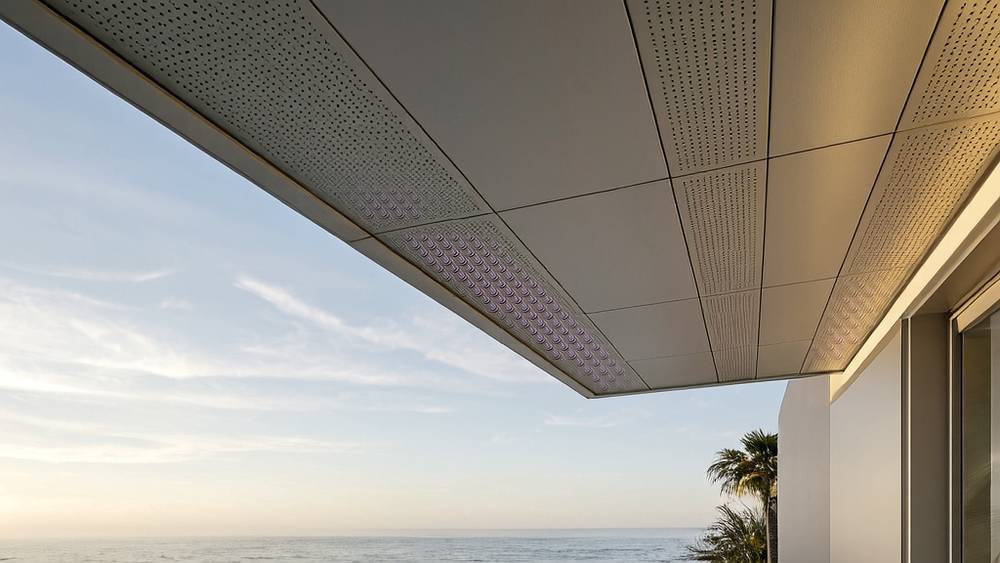
Every architect who specifies aluminium soffit panels for coastal projects eventually faces the same uncomfortable question: will this material still look acceptable in five years, or will the client be calling about chalked surfaces and patchy corrosion? The answer depends less on the aluminium itself and more on what sits between the metal and the salt-laden air. Marine environments accelerate coating degradation at a rate that surprises even seasoned specifiers. A project completed in Miami Beach or Jeddah in 2018 can already show meaningful differences between panels that were coated to different standards. Understanding what those standards actually test, and where they fall short, separates a soffit installation that weathers gracefully from one that becomes a persistent maintenance liability.
The Salt Spray Problem That Standard Tests Do Not Fully Capture
ASTM B117 neutral salt spray testing runs a continuous 5% NaCl fog at 35°C for 3,000 hours in premium architectural specifications. Most PVDF coatings on aluminium soffit panels pass this without blistering or significant creep at the scribe line. The problem is that real marine exposure is not a continuous fog. It cycles between wet salt deposition, drying, and UV exposure. Salt crystals form on the panel surface during dry periods, then redissolve when humidity spikes. This cyclic concentration effect drives chloride ions deeper into any microscopic coating defect than the steady-state B117 condition ever will.
Cyclic corrosion testing methods like ASTM G85 Annex A5 (modified salt spray with cyclic wet/dry transitions) produce results that correlate more closely with field performance in coastal zones. When comparing coating systems for aluminium soffit panels within 500 metres of breaking surf, ask suppliers for G85 data, not just B117. A coating that survives 3,000 hours of B117 may begin showing pinpoint blisters after 1,000 hours of cyclic G85. The difference matters because soffit panels, unlike vertical wall cladding, collect salt deposits that gravity does not wash away. Rain cleans vertical surfaces. Horizontal and near-horizontal soffit surfaces accumulate everything the wind delivers.
PVDF, FEVE, and Polyester: What 15 Years of Field Data Reveals
Three coating chemistries dominate the aluminium soffit panels market for architectural applications. Each brings different molecular-level resistance to the alkaline conditions that salt spray creates. PVDF (polyvinylidene fluoride), typically formulated as a 70/30 blend with acrylic resin, relies on extremely strong carbon-fluorine bonds that resist UV photodegradation and chemical attack. The 70% PVDF resin content specified in AAMA 2605 delivers the benchmark performance for coastal soffit applications, but even this standard permits meaningful variation between licensed coating manufacturers.
FEVE (fluoroethylene vinyl ether) coatings approach PVDF performance levels while offering higher gloss ranges and the ability to cure at ambient temperatures. This matters for aluminium soffit panels that require field touch-up after installation. PVDF requires a thermal cure at 230-250°C, which means factory application only. FEVE systems can be field-applied with proper preparation, making them relevant for renovation projects where removing panels for factory recoating is impractical.
Polyester coatings, whether standard or super-durable silicone-modified variants, should not be specified for aluminium soffit panels within 5 kilometres of a marine coastline. Field surveys of Florida condominium projects show that super-durable polyester on soffit panels begins showing measurable gloss reduction (more than 50% loss from initial 60° gloss readings) within 3-5 years of coastal exposure. The same survey found PVDF-coated panels retaining 80% or more of initial gloss after 10 years at the same sites.
| Coating Type | Resin System | Salt Spray Resistance (ASTM B117) | Cyclic Corrosion (ASTM G85 A5) | 60° Gloss Retention After 10 Years Coastal | Recommended Distance from Coast |
|---|---|---|---|---|---|
| PVDF (AAMA 2605) | 70% PVDF / 30% Acrylic | 4,000+ hrs no blistering | 2,000+ hrs rating 8+ | >80% | Any distance |
| FEVE (AAMA 2605) | Fluoroethylene Vinyl Ether | 4,000+ hrs no blistering | 2,000+ hrs rating 8+ | >75% | Any distance |
| PVDF (AAMA 2604) | 50-70% PVDF blend | 3,000 hrs minimal blistering | 1,500 hrs rating 6-7 | 60-75% | 1 km minimum |
| Super-Durable Polyester | Silicone-modified Polyester | 1,500 hrs | 800 hrs rating 4-5 | 40-55% | 5 km minimum |
| Standard Polyester | Polyester / Melamine | 500-1,000 hrs | Not recommended | <30% | Not recommended for exterior soffit |
Aluminium Alloy Selection: Why 3003 and 5052 Respond Differently to Salt
Coating performance dominates the conversation, but the substrate alloy underneath matters considerably for aluminium soffit panels in marine service. Standard architectural aluminium uses 3003-H14 alloy, a manganese-alloyed grade with adequate strength and excellent formability for flat soffit panels. Its corrosion resistance in atmospheric exposure is good, but in chloride-rich environments, the copper content (0.05-0.20%) becomes relevant. Even trace copper can initiate pitting corrosion at sites where the coating has been mechanically damaged during installation or maintenance.
Alloy 5052-H32, a magnesium-alloyed grade with no intentional copper addition, offers measurably better resistance to saltwater pitting. The magnesium content (2.2-2.8%) provides solid-solution strengthening without the galvanic corrosion risk that copper introduces. For aluminium soffit panels specified on projects within 200 metres of breaking surf, or on elevated walkways and balconies where spray directly contacts the panels, 5052 provides an additional margin of safety beneath the coating. The cost premium is typically 8-12% over 3003, which on a soffit package may represent less than 1% of the total facade budget.
Futeng® produces both 3003 and 5052 aluminium soffit panels and has observed that coastal project specifications increasingly require 5052 as the default substrate, particularly in Middle Eastern and Southeast Asian markets where high humidity combines with coastal salinity to create exceptionally aggressive exposure conditions.
Edge Preparation and Cut-End Corrosion: The Weak Point Most Specifications Miss
The factory-coated face of an aluminium soffit panel carries the full coating system: pretreatment conversion coating, primer, and PVDF topcoat. The cut edges do not. When a 3,000 mm panel is cut to length on site, the exposed aluminium edge faces direct environmental attack. In marine conditions, this edge becomes the initiation point for filiform corrosion, a thread-like underfilm attack that creeps beneath the coating from the cut edge inward at rates of 0.5-2.0 mm per year.
Three practical measures address this vulnerability. First, specify that all panels be cut to final dimensions at the factory where possible, so cut edges receive a field-applied touch-up coating before shipping. Second, require that any unavoidable site-cut edges be treated with a chromate-free conversion coating pen and two-coat liquid touch-up system matched to the factory coating chemistry. Third, design perimeter trims and edge profiles so that cut edges face inward or are shielded from direct salt spray exposure. The AAMA 609.1 and 610.1 standards for cleaning and touch-up of architectural anodized and painted aluminium provide procedural guidance, though they were written primarily for storefront and curtain wall rather than specifically for aluminium soffit panels.
Installation sequencing also matters. Soffit panels installed early in the construction programme may sit exposed for months before the building envelope is closed and HVAC systems begin managing interior humidity. This unprotected exposure period, especially in coastal climates, can initiate edge corrosion that propagates beneath the coating long after the building is occupied. Specifications should require protective temporary edge treatments or sequencing that minimises exposed duration.
Ventilation Requirements and the Corrosion Trade-Off
Aluminium soffit panels in most building applications must provide ventilation to the attic or eaves space above. Building codes typically require a net free ventilating area of 1/150 to 1/300 of the attic floor area, depending on climate zone and vapour retarder installation. The International Residential Code (IRC) Section R806 and the International Building Code (IBC) Section 1203 provide the governing requirements in US-based projects.
Ventilation creates a corrosion trade-off. Perforated or louvered panels allow salt-laden air to pass through the panel plane, exposing the interior face of the soffit panel and the supporting substructure to the same marine atmosphere that attacks the exterior face. The interior face typically carries only a wash coat or mill finish rather than the full PVDF system. Over time, this interior surface can develop white corrosion products that are structurally insignificant but visually concerning if visible through the perforations.
For marine-environment aluminium soffit panels requiring ventilation, specifying a minimum 5-micron polyester wash coat on the reverse side provides basic protection. Perforation patterns should be designed with hole diameters of 3-4 mm rather than larger openings, balancing airflow with reduced line-of-sight visibility to the interior cavity. Open-joint soffit systems, which Longboard Architectural Products references in their Panelboard product literature, can provide ventilation without perforations by using gaps between planks, but these systems require careful detailing of the drainage plane above the soffit to manage wind-driven salt spray that penetrates the joints.
Substructure Compatibility: Avoiding Galvanic Cells Above the Soffit Line
The aluminium soffit panels themselves may resist corrosion adequately, but the substructure that supports them can create electrochemical problems. Galvanised steel hat channels and hanging brackets are common in soffit applications because they are inexpensive and familiar to installers. When aluminium panels contact galvanised steel in the presence of an electrolyte such as salt-laden condensation, a galvanic cell forms. Aluminium is anodic to both zinc and steel in the galvanic series, meaning the aluminium corrodes sacrificially to protect the steel.
The voltage difference between aluminium and zinc in seawater is approximately 0.3-0.5 volts depending on temperature and chloride concentration. This is sufficient to drive measurable corrosion of the aluminium panel at contact points within 12-18 months of marine exposure. The solution is straightforward: specify a physical separator between dissimilar metals. EPDM gaskets, nylon washers, or PVC isolation tape at every fastener and bearing point break the electrical circuit. Stainless steel fasteners (grade 316 for marine, not 304) should be used for all aluminium soffit panel connections in coastal environments. The incremental material cost of isolation detailing is negligible compared to the cost of replacing corroded panels five years after handover.
Aluminium substructure eliminates the galvanic compatibility issue entirely but introduces its own considerations. Extruded aluminium carriers and hanging systems must use the same alloy series as the panel (5000-series substructure with 5052 panels) or be isolated if mixing series. The AAMA TIR-A9 technical information report provides guidance on metal-to-metal contact in architectural aluminium assemblies, though specifiers should supplement it with project-specific corrosion engineering for severe marine sites.
Cleaning and Maintenance Protocols That Extend Coastal Service Life
Even correctly specified aluminium soffit panels with PVDF coating and isolated substructure need cleaning in marine environments. Salt deposits left on panel surfaces for months create localised concentration cells during dew events, driving chloride ions into the coating at a microscopic level. A six-month cleaning interval is the minimum recommendation for buildings within 500 metres of open ocean. The cleaning protocol should use low-pressure water (below 1,000 psi), mild pH-neutral detergents, and soft bristle brushes to avoid burnishing the PVDF surface.
Abrasive cleaning or high-pressure washing at close range damages the PVDF surface layer by creating micro-scratches that retain salt more effectively than the intact coating. These scratches become nucleation points for premature coating breakdown. The financial implication is significant: a 20-storey coastal residential tower with approximately 2,000 m² of aluminium soffit panels represents a material and installation investment of roughly $180,000-280,000 depending on panel complexity. Proper maintenance over a 20-year service life costs perhaps $40,000-60,000 in total. Premature replacement due to coating failure can exceed the original installation cost once access equipment, logistics, and business interruption are factored in.
Specification Checklist for Marine-Environment Aluminium Soffit Panels
Converging the technical threads into a practical specification framework helps avoid the most common failure modes. The following points should form the core of any marine-service soffit specification:
- Coating must meet AAMA 2605 with minimum 70% PVDF resin, supported by both ASTM B117 (4,000+ hours) and ASTM G85 A5 (2,000+ hours) test data from the coating manufacturer
- Aluminium alloy 5052-H32 specified for all panels within 200 metres of breaking surf; 3003-H14 acceptable beyond 200 metres with 2605 coating
- Factory-cut edges preferred; site-cut edges must receive two-coat PVDF-compatible touch-up treatment within 24 hours of cutting
- Reverse side of perforated panels to receive minimum 5-micron polyester wash coat, not mill finish
- All dissimilar metal contact points isolated with EPDM or nylon separators; fasteners to be 316 stainless steel minimum
- Substructure to be aluminium (5000-series preferred) or fully isolated galvanised steel
- Cleaning access incorporated into building maintenance strategy with documented six-month interval protocol
- Warranty: minimum 20-year film integrity for coating on coastal projects, not the 10-15 years typical for inland applications
Coastal aluminium soffit panel failures almost never trace to a single catastrophic error. They result from accumulated small decisions: a polyester wash coat instead of PVDF on the reverse side, a zinc-plated fastener instead of stainless, a cut edge left untreated during a rain event. Each compromise seems trivial in isolation. Together, across hundreds of panels and years of exposure, they produce the chalking, blistering, and edge creep that some building owners have accepted as inevitable. It is not inevitable. The coating, alloy, and detailing knowledge exists. The gap between knowledge and outcome is where specification discipline either holds or fails.
For procurement teams evaluating supplier proposals for marine-environment aluminium soffit panels, the lowest bid typically achieves its pricing by trading off one or more of the protective layers described above. The appropriate question when reviewing a bid that undercuts competitors by 15% or more is not "what are we saving" but "which layer of protection has been removed." In coastal conditions, the answer becomes visible on the building within five years.