How 20 mm Aluminium Honey Comb Panels Match 6 mm Solid Plate Stiffness at Half the Weight
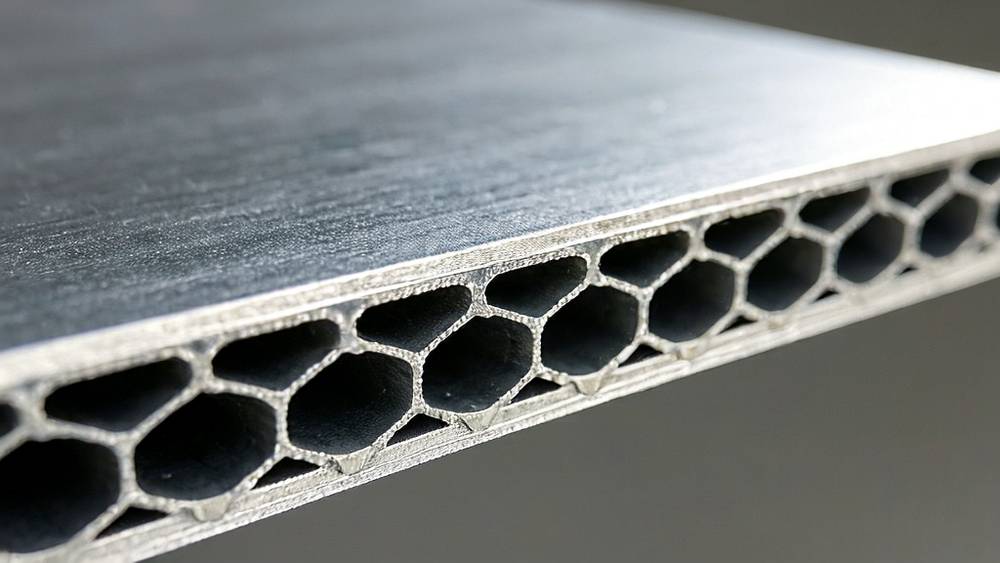
When a cladding panel weighs 40% less than solid aluminium plate yet delivers equivalent bending stiffness, the structural arithmetic changes. This is not marketing hyperbole. It is the mechanical reality of sandwich panel engineering, and it sits at the heart of why aluminium honey comb panels have moved from aerospace hangars to building envelopes over the past 15 years. The hexagonal core geometry, originally developed for aircraft flooring in the 1940s, now supports rainscreen facades, canopy soffits, and column covers across projects where dead load governs the attachment design. For the procurement manager evaluating a 12,000 m² facade package or the structural engineer checking mullion reactions, one number matters more than any brochure claim: the panel's areal weight at a given bending stiffness. That relationship, expressed in kilograms per square metre per newton-metre of flexural rigidity, determines whether existing steelwork can carry the new skin or whether a costly reinforcement programme awaits. This article examines that exact relationship through the lens of aluminium honey comb sandwich construction, drawing on manufacturer data, Eurocode deflection limits, and the manufacturing tolerances that separate a calibrated panel from a liability.
How Sandwich Stiffness Rewrites Cladding Weight Arithmetic
The engineering principle is straightforward but its implications are not. A solid aluminium sheet of thickness t has bending stiffness proportional to t³. Double the thickness and stiffness increases eightfold, but so does weight. An aluminium honey comb panel replaces the middle portion of that solid sheet with a low-density hexagonal core, bonding thin face sheets to either side. The faces carry bending stresses in tension and compression. The core transfers shear between them. The result: a panel 20 mm thick with 1.0 mm faces and a 29 kg/m³ core may weigh 8.5 kg/m² yet deliver bending stiffness equivalent to a 6 mm solid aluminium plate weighing 16.2 kg/m².
This stiffness-to-weight ratio is not linear. It shifts with core density, cell size, foil gauge, and adhesive type. EURO-COMPOSITES® supplies aluminium honey comb core at densities from 29 kg/m³ to 130 kg/m³, with cell sizes ranging from 6.4 mm to 19.2 mm. The 29 kg/m³ grade, often specified for interior architectural panels, uses 0.05 mm foil thickness. At 130 kg/m³, foil gauge rises to approximately 0.12 mm, delivering higher shear modulus for structural floor panels and blast-rated facades. The selection cascade works like this: higher core density increases shear stiffness and flatwise compressive strength but adds weight; thinner faces reduce weight but lower bending stiffness; larger cell sizes reduce cost but also reduce the bonded area between core and face, which can affect long-term peel resistance under thermal cycling.
| Panel Configuration | Face Thickness (mm) | Core Density (kg/m³) | Total Thickness (mm) | Areal Weight (kg/m²) | Flexural Rigidity EI (N·m²/m) |
|---|---|---|---|---|---|
| Solid aluminium sheet | 3.0 | N/A | 3.0 | 8.1 | ~1,950 |
| Solid aluminium sheet | 4.0 | N/A | 4.0 | 10.8 | ~4,620 |
| Honeycomb sandwich | 0.7/0.7 | 29 | 15 | 4.6 | ~3,800 |
| Honeycomb sandwich | 1.0/1.0 | 50 | 20 | 6.8 | ~8,900 |
| Honeycomb sandwich | 1.0/1.0 | 72 | 25 | 8.5 | ~14,200 |
| Honeycomb sandwich | 1.5/1.5 | 130 | 30 | 14.7 | ~38,500 |
Source note: Flexural rigidity values are calculated approximations based on sandwich beam theory (face modulus E ≈ 70 GPa for 3003/5052 alloy, core shear modulus Gc varies by density). Actual values depend on adhesive type, cure cycle, and manufacturer-specific core expansion ratios. Always request certified test reports per ASTM C393.
The 20 mm Panel That Outperforms 4 mm Solid Aluminium
Consider a rainscreen panel spanning 1,200 mm between support rails, wind load of 1.5 kPa (serviceability limit state). Under Eurocode deflection limits of L/200, the permissible mid-span deflection is 6.0 mm. A 4 mm solid aluminium panel (alloy 3003-H14) weighs 10.8 kg/m² and deflects approximately 5.2 mm, passing the check but consuming most of the allowance. A 20 mm aluminium honey comb panel with two 1.0 mm face sheets and a 50 kg/m³ core weighs 6.8 kg/m² and deflects roughly 2.8 mm under the same load. It passes with 53% of the deflection budget remaining.
That remaining budget matters. It allows the same panel to handle a 2.4 kPa suction load at building corners without changing the support grid. It means the structural engineer can push rail centres to 1,500 mm, saving 20% on subframe linear metres. On a 20-storey tower with 8,000 m² of cladding, the dead load reduction from 86.4 tonnes (solid 4 mm) to 54.4 tonnes (honeycomb 20 mm) filters through every bracket, every anchor channel, every mullion splice. The secondary steelwork might drop one section size. The crane time might shorten. These are the cost vectors that project directors track, and they all trace back to the bending stiffness arithmetic inside the panel specification.
But the arithmetic has boundary conditions. The faces must resist localised denting from handling and impact. A 1.0 mm face on a honeycomb panel dents more readily under point loads than a solid 4 mm sheet. For ground-floor zones or areas accessible to pedestrian contact, some specification writers increase face thickness to 1.5 mm or specify a 72 kg/m³ core for improved flatwise compressive strength, which for aluminium honey comb structures typically ranges from 0.8 MPa (29 kg/m³) to 4.2 MPa (130 kg/m³). The trade-off between weight saving and damage tolerance is project-specific and should be documented in the performance specification rather than left to the installer's discretion.
Corex Data and What Cell Size Means for Bond Integrity
Corex Honeycomb, a UK-based core manufacturer, publishes data showing aluminium honey comb core in cell sizes from 6.4 mm (1/4") to 19.2 mm (3/4"). The smaller the cell, the more foil surface area per unit volume for adhesive bonding, and the higher the peel strength. For architectural panels exposed to daily thermal cycles—where dark PVDF-coated surfaces can reach 80°C in summer and drop to -10°C in winter—the differential expansion between the 3003 aluminium face and the 3003 core foil is negligible because the alloys are metallurgically similar. But the adhesive layer experiences cyclic shear stress at the face-core interface. A panel with 6.4 mm cells has approximately three times the bonded perimeter per unit area compared to a 19.2 mm cell, which translates to higher peel resistance after 5,000 thermal cycles.
This matters because some procurement routes prioritise cost per square metre delivered to site over lifecycle performance. A 19.2 mm cell core costs less to manufacture than a 6.4 mm cell core and produces a panel that looks identical on a specification data sheet. The thickness, weight, and stiffness figures may match. Only the peel strength and long-term durability differ. ASTM C393 (flexural properties of sandwich constructions) and ASTM D1781 (climbing drum peel test) are the two test standards that separate panels built for architectural permanence from those built for price-point tendering.
Manufacturing Tolerances That Affect Installed Flatness
Panel flatness is not solely a property of the aluminium honey comb core. It results from the interaction of face sheet flatness, core expansion uniformity, adhesive spread consistency, and press cycle control. The core manufacturing process—expanding sliced foil blocks into hexagonal geometry—introduces a characteristic "core ripple" that can telegraph through thin faces if the adhesive film weight is too low or if the press platen is not maintained parallel to within 0.1 mm across the panel width.
Pacific Panels, a specialist manufacturer, describes the bonding process using high-strength adhesive films cured under controlled heat and pressure. The quality of this bond line directly affects whether a 3 m × 1.5 m panel exhibits the ±1.5 mm flatness that a close-joint rainscreen system demands. Some project specifications reference AAMA 508 (voluntary specification for flatness tolerances) or the flatness requirements embedded within EN 14509 for self-supporting sandwich panels. However, aluminium honey comb rainscreen panels often fall between these standards because EN 14509 primarily addresses structural sandwich panels for roofing, while AAMA 508 focuses on solid aluminium plate. The specifier must therefore write a custom flatness tolerance, typically ±0.5 mm over 300 mm and ±2.0 mm over the full panel diagonal, and require the manufacturer to demonstrate capability with first-article inspection reports.
Futeng® aluminium honey comb panels, manufactured in a facility with CNC-controlled press lines and automated adhesive film application, address this tolerance challenge through statistical process control on every production batch. The key metric is not the average flatness of 100 panels but the standard deviation. A process with a standard deviation of 0.3 mm on flatness will produce fewer out-of-tolerance panels than one with a 0.7 mm deviation, even if both claim ±2.0 mm capability. Procurement teams evaluating factory audits should request process capability indices (Cp and Cpk) for flatness, not just pass/fail inspection records.
Eurocode Deflection Limits and the Honeycomb Advantage in Tall Facades
EN 13830, the European product standard for curtain walling, specifies deflection limits for facade members under wind load. For framing members, the limit is typically L/200 or 15 mm, whichever is smaller. For infill panels, the limit is often tightened to L/300 when brittle finishes such as ceramic frit or stone veneer are bonded to the face. A honeycomb panel's high flexural rigidity per unit weight becomes particularly valuable at tighter deflection limits because the panel's self-weight contributes less to the mullion's total deflection.
Consider a 4,500 mm tall mullion span carrying panels at 1,500 mm centres. The panels impose a dead load reaction at each connection bracket. Switching from solid 4 mm aluminium (10.8 kg/m²) to a 25 mm honeycomb panel (8.5 kg/m²) reduces the dead load per bracket by approximately 21%. For a mullion already stressed near its moment capacity under wind load, this reduction may eliminate the need for steel reinforcement sleeves or allow a lighter aluminium extrusion. The honeycomb panel's own deflection under wind load is lower, so less of the mullion's deflection budget is consumed by panel flexure. This interaction—panel stiffness reducing mullion demand—is often overlooked in the linear calculation path where the structural engineer assumes the panel contributes no stiffness to the system. Modern finite element modelling of the complete facade assembly, including the rotational restraint provided by stiff honeycomb panels at mullion connections, can yield a more efficient design than the traditional sequential approach.
Core Density Selection for Specific Architectural Applications
The range of aluminium honey comb core densities from 29 kg/m³ to 130 kg/m³ corresponds to distinct application bands, not arbitrary options.
- 29 kg/m³: Interior wall linings, lift car panels, ceiling panels. Minimal structural demand. The core serves primarily as a spacer to create panel thickness for perceived quality and acoustic damping. Flatwise compressive strength approximately 0.8 MPa.
- 50 kg/m³: Exterior rainscreen panels on low-rise buildings (up to 15 m), soffit panels under canopies, column covers. Moderate wind loads. Compressive strength approximately 1.6 MPa.
- 72 kg/m³: High-rise rainscreen (above 15 m), spandrel panels, panels with large unsupported spans exceeding 1,500 mm. Compressive strength approximately 2.8 MPa.
- 130 kg/m³: Floor panels, blast-resistant facades, heavy-traffic soffits, structural sandwich panels where the core contributes to system stiffness under EN 14509. Compressive strength approximately 4.2 MPa.
These bands overlap. A 50 kg/m³ core with 1.5 mm faces may outperform a 72 kg/m³ core with 1.0 mm faces for a specific span and load. The correct selection requires the manufacturer to run the sandwich beam equations with the specific alloy temper, face thickness, core density, and adhesive shear modulus for each project, not to pull a pre-calculated span table from a catalogue written for a different wind zone and support condition.
EURO-COMPOSITES® also applies a zirconium oxide coating to its aluminium honey comb core to prevent corrosion. This matters in coastal installations (within 5 km of salt water) where the core, though enclosed between face sheets, can be exposed to condensation or minor seal failures over decades of service. The zirconium oxide treatment creates a barrier that resists the pitting corrosion that can initiate in untreated 3003 alloy honeycomb foil under chloride exposure. Specification writers for marine environments should request evidence of salt spray testing per ASTM B117 on the core material, not just on the assembled panel.
Testing Beyond the Data Sheet: What Site QA Should Verify
Factory production control under ISO 9001 provides a baseline. For aluminium honey comb panels on building envelopes, three additional verification steps distinguish a competent procurement from one that discovers problems during installation.
First, flatwise tensile strength (ASTM C297) measures the bond strength between face and core. Values below 1.0 MPa indicate inadequate adhesive coverage or cure. A panel that passes bending stiffness tests can still fail in flatwise tension if the adhesive film was stored beyond its shelf life or if the press temperature was 5°C below the adhesive manufacturer's specified cure window.
Second, climbing drum peel (ASTM D1781) measures the torque required to peel the face from the core. This test detects weak bond lines that a static tensile test might not reveal. A panel with adequate flatwise tensile strength but low peel resistance can delaminate progressively under wind-induced vibration or thermal cycling.
Third, full-panel flatness under simulated service temperature. Measure panel flatness at 20°C, then heat the panel to 80°C uniformly and measure again. Core materials with residual stresses from incomplete expansion can cause panels to bow when heated—a failure mode that appears only after the dark-coloured cladding has been installed and exposed to summer sun. The acceptance criterion should be that the change in flatness between 20°C and 80°C does not exceed 50% of the room-temperature tolerance.
These tests are not academic. They are specified in project quality plans for demanding facades and should be budgeted at 0.5% to 1.5% of the panel contract value, depending on the testing scope and whether an independent laboratory witness is required.
Procurement Strategy: Specifying Aluminium Honey Comb Without Inviting Value Engineering Traps
The most common value engineering substitution in aluminium honey comb panel procurement is a reduction in core density with a compensatory increase in face thickness, presented as "equivalent stiffness at lower cost." The stiffness may indeed be equivalent at room temperature under a single load cycle. The substitution falls apart under repeated thermal cycling, where the reduced bonded area of the lower-density core (fewer cells per unit area, thinner foil gauge) leads to progressive peel failure starting at panel edges.
The procurement defence against this is a performance specification that defines required values for:
- Flexural rigidity EI (N·m²/m), minimum, tested per ASTM C393
- Flatwise tensile strength (MPa), minimum, tested per ASTM C297 after 500 thermal cycles (-20°C to +80°C)
- Climbing drum peel strength (N·mm/mm), minimum, tested per ASTM D1781
- Flatness deviation (mm), maximum, measured at 20°C and 80°C
When these four parameters are contractual requirements, the manufacturer cannot substitute a cheaper core without failing at least one test. The specification becomes the quality gate, not a wish list.
The aluminium honey comb panel market serves projects from airport terminals to museum facades to high-rise residential towers. The common thread across all applications is that the panel's value lies not in how it looks on a sample board but in how it performs over 25 years of wind, sun, and thermal cycles. The stiffness-to-weight arithmetic that makes these panels attractive at the bid stage must be backed by manufacturing consistency and verified by testing that goes beyond the data sheet. For the engineer, that means writing a specification with teeth. For the procurement manager, it means auditing the factory, not just the price. For both, it means understanding that aluminium honey comb is a structural sandwich, not a decorative sheet—and treating it accordingly in every line of the contract.