Fabrication Complexity Adds 40 Percent to Aluminum Panels Price
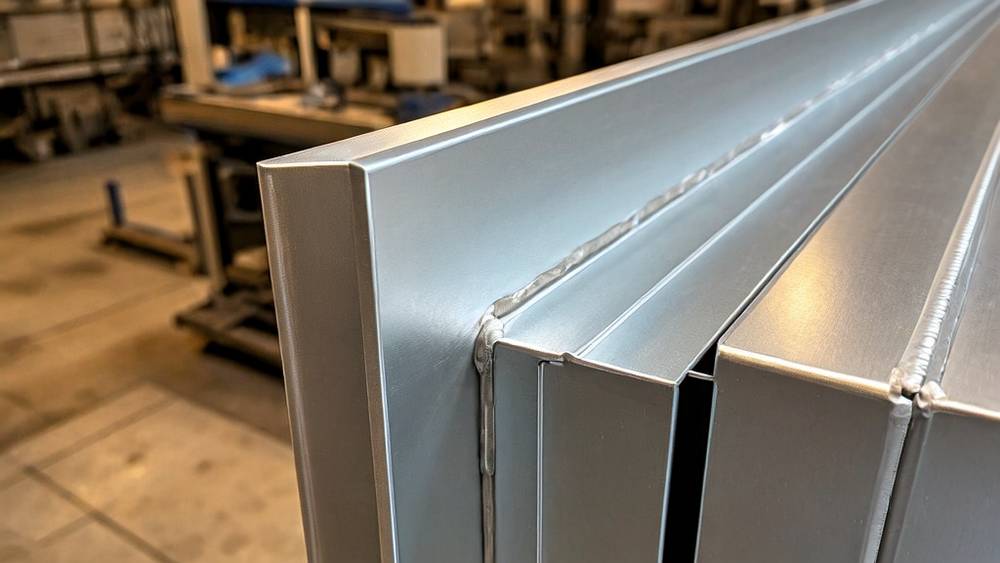
When a facade contractor asks about aluminum panels price, the number that hits the spreadsheet is rarely just the raw sheet cost. Behind every square-meter quote sits a chain of decisions: panel thickness, alloy grade, coating system, perforation ratio, and — most overlooked — how much welding and folding each panel demands. A flat 2.5 mm solid aluminium rainscreen panel with standard PVDF coating might land at $38–52/m² material-only. Add Z-shaped returns on four sides, three stiffener profiles, and a custom RAL match, and that same panel can push past $85/m² before it leaves the factory.
This article zeroes in on one specific cost driver that purchasing managers consistently underestimate: fabrication complexity. Not the generic "custom panels cost more" advice. We are talking about the measurable fabrication variables — return leg height, stiffener count per panel, folded edge geometry, and welded corner reinforcement — that separate a commodity flat sheet from a fully engineered rainscreen element. If your project involves panels larger than 1,200 mm in any dimension, or if your facade design calls for open-joint systems with visible edges, the fabrication surcharge can outweigh the raw aluminium cost by a factor of two or more.
We base these figures on current 2026 factory pricing patterns observed across East Asian and Middle Eastern supply chains, cross-referenced with the cost modeling methodology outlined by the American Architectural Manufacturers Association (AAMA) for finished aluminium components. Every dollar figure here references solid aluminium panels — typically 1100, 3003, or 5052 alloy — not aluminium composite material (ACM) or honeycomb-core panels.
What "Fabrication Complexity" Actually Means on a Solid Aluminium Panel Quote
Raw aluminium coil or sheet — 1.5 mm to 3.0 mm gauge, mill finish — trades as a commodity. The London Metal Exchange (LME) aluminium price plus regional conversion premiums set that baseline. For a standard 2.5 mm 3003-H14 sheet, raw material cost runs roughly $3.80–4.50/kg depending on volume and supplier. That is the easy part of the negotiation.
Fabrication complexity enters when the panel stops being a rectangle with four simple edge bends and becomes a three-dimensional component. Every additional operation — each fold, each welded corner, each stiffener tacked to the rear face, each slotted hole routed for a secret-fix clip system — adds direct labor minutes, machine time, and quality inspection overhead. A panel with 12 fabrication steps versus one with four steps can triple the factory processing cost even though both panels use the same alloy, the same thickness, and the same coating specification.
The challenge for procurement teams is that fabrication complexity does not appear as a separate line item on most factory quotations. It is buried inside the "panel fabrication charge" or "processing surcharge," which makes benchmarking across suppliers frustrating. Two factories quoting $62/m² for the same panel specification may be arriving at that number through entirely different cost structures — one might allocate more to raw material and less to labor, while the other runs the opposite ratio. Understanding the underlying fabrication variables lets you ask the right questions during technical clarification meetings.
The Six Fabrication Variables That Shift Aluminum Panels Price by 40% or More
1. Return Leg Height and Fold Count
A panel with a 20 mm return leg on all four edges requires four simple brake-press folds. A panel with 50 mm return legs on all four edges — typical for open-joint rainscreen systems where the panel edges remain visible — involves the same four folds but demands a longer flat blank, more material, and slower machine setup. The material waste factor jumps from roughly 8% to 15% of the flat sheet area because the corners require notching and the blank size increases disproportionately to the finished face dimension.
Panels that specify return legs on only two edges (top and bottom, for example, with sides left flat for interlocking horizontal joints) reduce fold count and material waste simultaneously. On a 20,000 m² project, specifying two-edge returns instead of four-edge returns can cut fabrication cost by an estimated $4–7/m² — a line item worth $80,000–140,000 on the total facade package.
2. Stiffener Profiles and Attachment Method
Solid aluminium panels spanning more than 600 mm between fixing points nearly always require rear stiffeners to resist wind-load deflection and oil-canning. The cost impact depends on three sub-variables: stiffener profile shape, material (aluminium extrusion vs. folded aluminium sheet vs. galvanized steel), and attachment method.
Aluminium hat-section extrusions, typically 25×25×2 mm or 30×30×3 mm in 6063-T5 alloy, cost $3.50–6.00 per linear meter depending on section and quantity. A large panel — say 1,500×3,000 mm — may need four vertical stiffeners at 400 mm centers, consuming 12 linear meters of extrusion. That adds $42–72 in stiffener material cost per panel. When the stiffeners are attached using intermittent MIG tack welds (which require grinding, flattening, and touch-up primer on the panel face), the labor component often exceeds the stiffener material cost.
An alternative is structural adhesive bonding using two-part epoxy or polyurethane adhesives, which eliminates weld marks and reduces post-processing. The adhesive itself costs $1.80–3.50 per linear meter of bond line, but the labor saving can offset this by 15–25% on panels where cosmetic requirements prohibit weld witness marks. This matters acutely for PVDF-coated panels in high-visibility areas, where even minor weld distortion can telegraph through to the finished surface.
3. Corner Welding and Watertightness
When a panel specification calls for fully welded and ground corners — common on canopy fascias, column cladding, and any application where the panel edges face upward and could trap water — the fabrication price increases by an estimated $8–15 per panel. The operation involves continuous TIG welding along each corner seam, grinding the weld bead flush, and often applying a zinc-rich primer to the weld zone before the main coating process.
Panels with folded corners only (no welding) rely on the brake-press fold geometry and a small drainage gap to manage water. These panels cost less to fabricate but are unsuitable for exposed horizontal surfaces or freeze-thaw climates where trapped water can expand and deform the corner. The specification decision between welded and folded corners should be made early — retroactively adding welded corners after the shop drawings are approved triggers change orders that compound both the fabrication cost and the schedule.
4. Perforation and Slotting
Perforated solid aluminium panels — used for acoustic cladding, ventilation screens, and decorative sun-shading — introduce CNC turret-punch or laser-cutting time directly proportional to the open-area ratio and hole pattern complexity. A panel with 20% open area using a standard staggered 8 mm round-hole pattern might add $12–18/m² in fabrication cost. The same panel with a custom slot pattern at 35% open area can add $28–40/m².
The hidden cost driver is sheet flatness after perforation. Punching thousands of holes releases residual stress in the aluminium sheet, often causing slight warping that requires re-flattening or additional stiffening. Factories that account for this in their quotation will price perforated panels 10–15% above the simple "perforation time plus material" calculation. Factories that do not account for it will deliver panels that oil-can on site, triggering rejection and rework costs that far exceed any initial saving.
5. Panel Size and Material Utilization Rate
Standard aluminium coil widths — typically 1,250 mm, 1,500 mm, and 2,000 mm — set a hard economic boundary on panel dimensions. A panel face dimension of 1,220 mm nests efficiently within a 1,250 mm coil, generating minimal trim waste. A panel face of 1,310 mm forces the factory to use 1,500 mm coil, wasting roughly 190 mm of width per panel — a 12.7% material utilization loss that flows directly into the per-square-meter price.
The same logic applies to panel length. Panels exceeding 3,000 mm in length may exceed standard sheet dimensions, requiring butt-welded joints or special-order sheet sizes with premium surcharges. On large-scale projects — airports, convention centers, logistics warehouses — optimizing panel dimensions to standard coil widths can reduce the overall aluminum panels price by 6–10% with zero compromise on architectural intent.
6. Coating System Interaction with Fabrication Sequence
The point in the manufacturing sequence where coating occurs changes the fabrication cost structure. Pre-coated coil (continuous coil coating) followed by fabrication means the cut edges, fold radii, and weld zones are uncoated — acceptable for interior panels or sheltered soffits but generally not for exterior rainscreen applications in corrosive environments.
Post-fabrication coating — where the fully fabricated panel (with stiffeners attached and corners welded) undergoes pretreatment and spray-applied PVDF or FEVE coating — ensures complete edge coverage. This sequence costs more because the three-dimensional panel must be hung, coated, and cured individually rather than processed as flat sheet. The coating labor surcharge for post-fabrication coating versus pre-coating is estimated at $5–9/m² for standard two-coat PVDF systems and $9–15/m² for three-coat metallic or mica finishes.
The AAMA 2605 specification for high-performance organic coatings on aluminium extrusions and panels sets the benchmark for exterior durability. Panels specified to AAMA 2605 with post-fabrication coating carry the highest fabrication cost but deliver 20+ years of color retention and chalk resistance — a trade-off that makes economic sense for institutional and premium commercial projects where recoating or panel replacement within the building lifecycle is unacceptable.
Fabrication Complexity Cost Breakdown: A Reference Table
The table below maps typical fabrication cost adders for a standard 2.5 mm solid aluminium panel (3003-H14 alloy) across six complexity levels. These figures represent factory-gate prices from established East Asian manufacturers in Q1 2026, excluding ocean freight, import duties, and on-site installation. All values in USD per square meter of finished panel face area.
| Complexity Level | Edge Detail | Stiffeners | Corners | Coating | Est. Fabrication Cost/m² | Panel Weight |
|---|---|---|---|---|---|---|
| Level 1 — Basic Flat | No returns, simple shear edges | None | None | Pre-coat PVDF 2-coat | $6–10 | 6.75 kg/m² |
| Level 2 — Simple Tray | 20 mm return, 4 edges | None | Folded only | Pre-coat PVDF 2-coat | $12–18 | 7.10 kg/m² |
| Level 3 — Standard Rainscreen | 30 mm return, 4 edges | 2 vertical hat extrusions | Folded only | Post-coat PVDF 2-coat | $22–30 | 7.80 kg/m² |
| Level 4 — Large-Format Rainscreen | 50 mm return, 4 edges | 4 vertical hat extrusions | Welded & ground | Post-coat PVDF 3-coat metallic | $35–48 | 8.50 kg/m² |
| Level 5 — Perforated Acoustic | 30 mm return, 4 edges | 3 vertical hat extrusions | Welded & ground | Post-coat PVDF 2-coat | $38–55 | 6.10 kg/m² (20% open) |
| Level 6 — Complex 3D Form | Variable, multi-angle folds | Custom steel subframe | Fully welded | Post-coat FEVE 3-coat | $55–80 | 9.20+ kg/m² |
Note that the fabrication cost column excludes raw aluminium material cost (approximately $12–15/m² for 2.5 mm sheet at LME ~$2,400/tonne) and excludes the coating material itself (roughly $4–7/m² for PVDF 2-coat paint system). Adding raw material, coating materials, and fabrication labor together gives the total ex-factory panel price — typically $38–52/m² for Level 3 panels and $68–102/m² for Level 5 and 6 panels. These figures align with the broader cost ranges documented in the Likton Metal 2026 cost guide for aluminium exterior wall panels, which reports $40–120/m² for solid aluminium systems depending on complexity.
How Fabrication Complexity Multiplies Across Project Scale
A 3,000 m² mid-rise office facade using Level 3 standard rainscreen panels at $42/m² factory price represents a $126,000 material package. If the architect specifies Level 4 large-format panels with welded corners and metallic coating at $68/m², the package jumps to $204,000 — a $78,000 difference attributable almost entirely to fabrication variables, not raw aluminium.
On a 25,000 m² project — an exhibition center or airport terminal — that same complexity delta translates to $650,000 in additional panel fabrication cost. The procurement implication is clear: fabrication complexity decisions made during the design development phase have seven-figure consequences on the installed facade budget. Waiting until the tender stage to value-engineer panel edge details, stiffener specifications, and coating sequences leaves money on the table that no amount of supplier negotiation can recover.
Smart procurement teams engage with panel fabricators during schematic design, not during tender. A technically competent supplier — Futeng®, for example, runs in-house engineering teams that review panel fabrication drawings against material utilization rates and machine capabilities before quoting — can flag cost-reduction opportunities that do not compromise the architectural intent. Reducing return leg height from 50 mm to 35 mm on a project where the wider return provides no functional benefit might save $3–5/m². Replacing welded corners with a folded-and-sealed detail on vertical applications can save $8–12 per panel. These are small per-unit adjustments that compound into meaningful budget relief at scale.
Why the Cheapest Quote Often Carries the Highest Fabrication Risk
When three factories quote the same panel specification and one comes in 18% below the median, the difference usually lies in fabrication assumptions — not raw material sourcing. Common cost-cutting tactics that show up in below-market quotes include:
- Skipping the post-weld grinding and re-flattening step, resulting in panels that meet dimensional tolerance on paper but exhibit visible distortion under grazing light
- Substituting extruded aluminium stiffeners with folded aluminium sheet stiffeners that have lower bending stiffness and may not meet the specified deflection limit under design wind load
- Using pre-coated coil for panels specified with post-fabrication coating, leaving uncoated cut edges that corrode prematurely in coastal or industrial environments
- Reducing stiffener attachment points from continuous adhesive bonding to intermittent tack welds without engineering review of the bond-line stress distribution
The ASTM B209 standard for aluminium and aluminium-alloy sheet and plate sets the material baseline, but it does not govern fabrication quality. That responsibility falls to the project specification — typically referencing AAMA 2605 for coating, AWS D1.2 for aluminium welding, and the project-specific fabrication tolerances defined in the architectural specification Section 07 42 13 for metal wall panels. A low fabrication price that fails to meet these referenced standards is not a saving; it is a latent defect claim waiting to surface during the defects liability period.
Practical Steps for Controlling Fabrication Cost Without Compromising Quality
- Standardize panel dimensions to coil widths. Work with the design team to adjust panel face dimensions so they nest efficiently within 1,250 mm, 1,500 mm, or 2,000 mm coil widths. A 20 mm adjustment to panel width can improve material utilization from 82% to 94% on a large production run.
- Minimize stiffener count through span optimization. Instead of defaulting to stiffeners at 400 mm centers, ask the panel engineer to calculate the actual required stiffener spacing based on the project wind load (typically per ASCE 7 in the US market or EN 1991-1-4 in European projects). A panel that spans 800 mm between primary fixing rails may need two stiffeners rather than three if the wind pressure is moderate.
- Specify return leg dimensions that match functional requirements. A 50 mm return leg provides stiffness and edge concealment for open-joint systems. A 25 mm return leg often suffices for face-sealed systems with cover trims. Do not default to the larger dimension unless the joint design requires it.
- Align the coating sequence with the exposure condition. Pre-coat PVDF is adequate for interior soffits, sheltered entrance canopies, and low-rise buildings in benign climates. Reserve post-fabrication coating for panels on buildings above six stories, coastal sites within 5 km of salt water, and industrial zones with airborne contaminants.
- Audit factory fabrication capabilities before awarding the contract. Visit the factory or commission a third-party audit. Confirm that the CNC brake presses can handle the panel dimensions, that the welding stations are staffed by certified aluminium welders, and that the coating line is qualified to the specified AAMA standard. The lowest aluminum panels price means nothing if the factory cannot execute the fabrication complexity your project demands.
Fabrication Complexity and the Total Installed Facade Cost
Panel fabrication cost is one component of the installed facade system cost, alongside the aluminium extrusion subframe (mullions, transoms, brackets), thermal isolation pads, fasteners, gaskets, and on-site labor. A useful rule of thumb for solid aluminium rainscreen systems in the US commercial market as of 2026: the panel ex-factory cost represents roughly 30–40% of the total installed facade cost. The subframe system accounts for 25–35%, on-site labor for 20–30%, and the remainder covers freight, duties, access equipment, and contingency.
This means that a $15/m² saving on panel fabrication translates to roughly $15/m² on the installed cost — the subframe and labor components do not change. Fabrication optimization therefore delivers near-dollar-for-dollar budget relief on the total facade package. The industry cost data compiled by CyanBuild supports this ratio, reporting installed metal wall panel costs of $20–70 per square foot ($215–753/m²) for commercial systems, with material cost representing 35–45% of the installed total.
For projects where the aluminum panels price is being benchmarked against alternative cladding materials — terracotta, fiber cement, HPL, or stone — the fabrication complexity discussion changes the comparison. A terracotta baguette system may have a lower material cost but higher subframe and labor costs due to the individual element handling. A solid aluminium panel system with optimized fabrication can close the total installed cost gap while offering superior spanning capability, lighter weight (reducing structural steel and foundation costs), and full recyclability at end of life.
Fabrication complexity is not a cost to be minimized at all costs — it is a design decision to be optimized. The most cost-effective panel is the one that meets the performance specification with the fewest fabrication steps, not the one with the lowest per-square-meter price on the quotation.
Returning to the core question that drives this analysis: the aluminum panels price that matters to a project budget is the fully fabricated, coated, and quality-inspected panel price — not the raw sheet price, not the pre-coat flat-sheet price, and certainly not the lowest bid that arrives with undisclosed fabrication shortcuts. Procurement professionals who understand the six fabrication variables outlined above can engage suppliers on equal technical footing, challenge cost assumptions that do not hold up to engineering scrutiny, and secure a facade package that balances budget discipline with long-term performance.