25 Year Cost of Aluminium Wood Grain Slats vs Hardwood on a 1000 m² Coastal Rainscreen
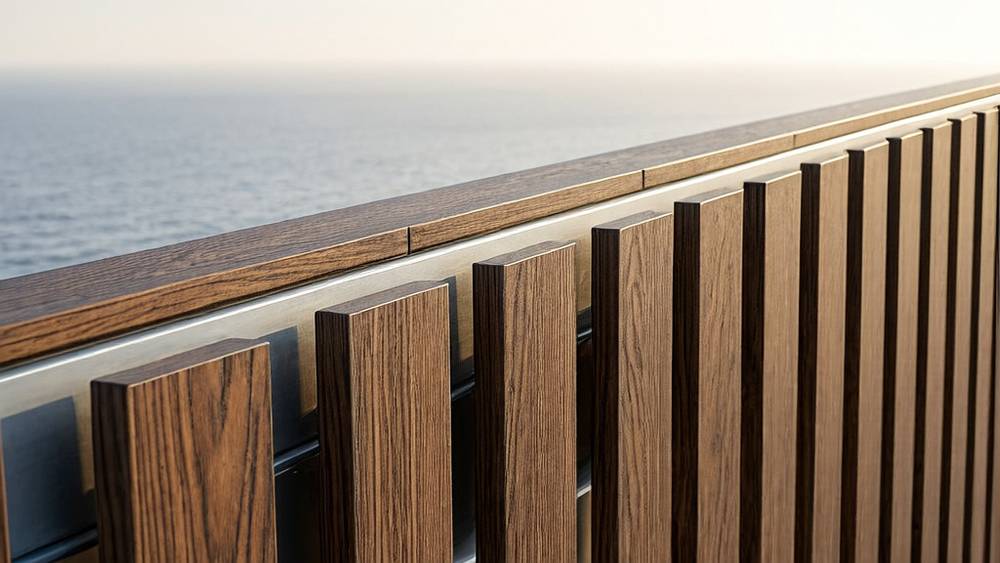
When a project specification calls for the warmth of timber on a rainscreen facade but the site sits within 500 metres of breaking surf, the answer is almost always aluminium wood grain slats. The logic is straightforward: real timber in marine environments rots, twists, and demands a repainting cycle that no facilities manager wants to budget for. Aluminium slats with a wood grain finish eliminate that cycle. But the question that procurement teams actually wrestle with is not whether to use them — it is how much they cost relative to genuine hardwood over a 25-year building lifecycle. The numbers are more surprising than most assume.
This article focuses on one specific calculation that gets overlooked during value engineering: the total cost of ownership differential between powder-coated aluminium wood grain slats and three common hardwood species — Iroko, Western Red Cedar, and thermally modified Ash — across a 1,000 m² ventilated facade. We factor material supply, substrate preparation, installation labour, and 25 years of maintenance at a coastal reference site. By the end, the spreadsheet tells a story that upfront square-metre pricing cannot.
Why Upfront Material Cost Tells Less Than Half the Story
Ask a quantity surveyor for the supply-only rate of 25×150 mm Western Red Cedar slats and they might quote £38–52 per m² depending on grade. Aluminium wood grain slats in an equivalent profile — typically 6063-T6 alloy with a two-coat PVDF or super-durable polyester wood grain transfer — run £65–95 per m² ex-works. On bid day, the timber number looks cheaper. The problem is that bid day is the only day timber looks cheaper.
Three cost drivers flip the comparison within the first five years:
- Substrate and fixing pack: Hardwood slats require stainless steel clips with a thermal break and an air gap that matches the species' movement coefficient. Aluminium wood grain slats use the same aluminium carrier system across the entire facade, eliminating mixed-metal isolation details.
- Wastage on site: Natural timber arrives with knots, sap runs, and bowing. A 15% cutting waste factor is considered acceptable practice. Aluminium extrusion yields below 3% waste because every linear metre is identical.
- Fire treatment cost: In any jurisdiction enforcing BS EN 13501-1 or ASTM E84, raw timber slats above a certain height require factory-applied fire retardant treatment — an additional £12–18 per m² that disappears when the specified material is non-combustible aluminium (Class A1 per EN 13501-1).
These line items do not appear on a material quote. They appear in the contractor's preliminaries and variation orders. For a facade consultant writing a performance specification, ignoring them creates a £40,000–70,000 gap between the tender estimate and the final account on a mid-rise project.
25-Year Maintenance: Where Aluminium Wood Grain Slats Pull Ahead
The single largest cost line in any timber rainscreen is not the timber. It is access. Re-coating a 15-metre elevation requires either a mast climber or suspended scaffold — both chargeable by the week. Below is a maintenance schedule comparison based on a C4 corrosion category site (coastal, salt-laden atmosphere per ISO 9223), which matches conditions from Brighton to Brisbane.
| Cycle | Western Red Cedar (Untreated) | Iroko Hardwood (Oiled) | Thermally Modified Ash | Aluminium Wood Grain Slats (PVDF/SDP) |
|---|---|---|---|---|
| Year 1-2 | Initial oil/stain application | Initial oil application | UV-protective oil | No maintenance required |
| Year 3-5 | Recoat — full scaffolding | Recoat — access platform | Recoat — access platform | Visual inspection only |
| Year 6-10 | Full strip and recoat; replace split/cupped boards | Recoat; sand weathered sections | Recoat; check end-grain checking | Mild detergent wash (water-fed pole) |
| Year 11-15 | Second full strip; 20-35% board replacement typical | Recoat; localised board replacement (10-15%) | Recoat; potential board replacement (15-20%) | Inspection; negligible intervention |
| Year 16-25 | Repeat cycle; cumulative board loss 40-60% | Recoat; cumulative board loss 25-35% | Recoat; cumulative board loss 30-40% | Inspection; possible localised re-coating of cut ends |
At a discounted cash flow rate of 5%, the net present value of 25-year maintenance for timber slats on a 1,000 m² facade ranges from £210,000 to £350,000 depending on species and access logistics. For aluminium wood grain slats with a properly specified PVDF wood grain system — such as those meeting AAMA 2605 requirements — the NPV of maintenance over the same period sits between £18,000 and £35,000. That is an order-of-magnitude difference.
What Drives That Maintenance Gap?
Three mechanisms destroy timber in service and leave aluminium untouched:
- UV-induced lignin breakdown: Wood's structural polymer degrades under ultraviolet exposure, causing surface fibres to loosen. This is why timber facades chalk and require sanding before recoating. Aluminium wood grain finishes use ceramic-based pigments in a fluoropolymer matrix that resists UV degradation at the molecular level.
- Hygroscopic movement: Timber expands and contracts with moisture content changes — typically 4-8% dimensional movement seasonally in temperate climates. This movement opens joints, cracks coatings, and creates water ingress paths. Aluminium's coefficient of thermal expansion (23.6 × 10⁻⁶/K for 6063 alloy) is predictable and accommodated by standard joint design.
- Biological attack: Marine borers, wood-boring beetles, and fungal decay are real threats in coastal and tropical climates. Aluminium wood grain slats are biologically inert. No treatment required, ever.
Installation Labour: The Hidden Multiplier
Timber installation looks simple on a detail drawing. In practice, each board must be individually selected, oriented for best face, pre-drilled to avoid splitting, and fixed with care to avoid crushing the grain. A competent rainscreen installer working with hardwood slats on a ventilated system achieves 6-10 m² per person per day. The same crew working with aluminium wood grain slats on a proprietary carrier system achieves 18-25 m² per person per day.
Why the difference? Aluminium slats arrive pre-cut to length with factory-applied wood grain finish on all visible faces. They clip into aluminium carriers with a consistent 15-20 mm gap. There is no grain orientation decision, no pre-drilling, and no risk of splitting at fixings. The installation logic is identical to any engineered aluminium rainscreen system — repetitive, fast, and tolerant of standard site conditions.
At a UK day rate of £280 per installer, the labour cost differential on 1,000 m² looks like this:
- Hardwood timber: 1,000 m² ÷ 8 m²/day = 125 person-days = £35,000
- Aluminium wood grain slats: 1,000 m² ÷ 20 m²/day = 50 person-days = £14,000
That £21,000 saving on labour alone covers roughly one-third of the upfront material premium for aluminium. When the main contractor sees these figures in a value engineering workshop, the conversation shifts from "aluminium is too expensive" to "why are we still pricing timber?"
Fire Compliance: The Cost That Catches Specifiers Off Guard
Building regulations post-Grenfell have transformed facade material selection globally. In the UK, Approved Document B requires materials on relevant buildings over 18 metres to meet limited combustibility requirements. In Australia, the National Construction Code (NCC) mandates non-combustible materials for Type A and B construction above specific heights. In the Middle East, civil defence codes increasingly reference NFPA 285 for exterior wall assemblies.
Solid aluminium wood grain slats are non-combustible — classified A1 under EN 13501-1 and meeting the requirements of ASTM E84 Class A. Timber slats, even with fire-retardant treatment, typically achieve Class B-s1,d0 or equivalent. That classification gap has contractual consequences:
- Timber on high-rise facades requires a fire-engineered justification, often involving full-scale NFPA 285 or BS 8414 testing of the specific system build-up — a cost of £25,000–50,000 per test.
- Aluminium systems have pre-existing test data from major system suppliers, reducing the need for project-specific fire testing.
- Insurance underwriters for commercial buildings increasingly price the facade material into their risk models. A non-combustible rainscreen can reduce the building's insurance premium by 5-10% annually.
For a procurement manager comparing two facade material bids, the fire compliance cost line can single-handedly eliminate timber from the running on any building over 11 metres.
25-Year TCO Model: 1,000 m² Facade, Coastal Site
Below is a consolidated total cost of ownership comparison. All figures in GBP at 2025 prices, discounted at 5% per annum where future costs are involved. The model assumes a C4 coastal environment, installation at 12 metres average height, and a ventilated rainscreen system on aluminium carriers.
| Cost Category | Iroko Hardwood | Western Red Cedar | Aluminium Wood Grain Slats (PVDF) |
|---|---|---|---|
| Material supply (1,000 m²) | £55,000 | £42,000 | £78,000 |
| Wastage allowance (15% timber / 3% aluminium) | £8,250 | £6,300 | £2,340 |
| Fire-retardant treatment (factory) | £15,000 | £15,000 | Not required |
| Carrier system & fixings | £32,000 | £32,000 | £28,000 |
| Installation labour | £35,000 | £35,000 | £14,000 |
| Fire testing contribution (project-specific) | £30,000 | £30,000 | £5,000 |
| Subtotal: Installed Cost Year 0 | £175,250 | £160,300 | £127,340 |
| 25-year maintenance (NPV) | £285,000 | £310,000 | £28,000 |
| 25-year insurance premium differential | +£45,000 | +£45,000 | Baseline |
| Total 25-Year Cost of Ownership | £505,250 | £515,300 | £155,340 |
The aluminium wood grain slats option delivers a 25-year saving of approximately £350,000 — roughly 69% below the cheapest timber alternative — despite an upfront material premium of 40-85% over hardwood. The crossover point where aluminium becomes cheaper than timber occurs in Year 3-4.
Wood Grain Finish Durability: PVDF vs Super-Durable Polyester
Not all aluminium wood grain slats carry the same finish warranty or weathering performance. The wood grain effect on aluminium is achieved through one of two dominant technologies:
- Sublimation transfer: A wood grain pattern is printed onto a transfer film and heat-sublimated into a polyester powder-coated substrate. The result is visually rich but relies on the underlying polyester for UV resistance. Typical warranty: 10-15 years for vertical applications.
- PVDF liquid coating with wood grain effect: A multi-coat PVDF system (primer, colour coat with wood effect, clear topcoat) meeting AAMA 2605. The fluoropolymer chemistry provides superior UV and chemical resistance. Typical warranty: 20-30 years.
For coastal projects where the cost model above applies, PVDF wood grain finishes are the only defensible choice. The salt spray resistance difference is measurable: PVDF systems withstand 4,000+ hours of ASTM B117 neutral salt spray testing with minimal change, while super-durable polyester systems typically reach 1,500-2,000 hours before filiform corrosion initiates at cut edges.
Suppliers such as Futeng® offer aluminium wood grain slats with PVDF wood-effect coatings tested to ASTM B117 and ISO 9227, providing specifiers with the documentation needed to validate the 25-year maintenance assumptions in the TCO model. The critical procurement check is to request the actual test reports — not just the warranty certificate — before accepting a substitution.
Where the TCO Model Breaks: When Timber Still Makes Sense
Honesty in value engineering means acknowledging the edge cases. Aluminium wood grain slats are not always the right answer. Timber remains viable in three specific scenarios:
- Listed buildings and conservation areas: Planning authorities in historic districts sometimes mandate natural materials regardless of lifecycle cost. No amount of TCO modelling overrides a conservation officer's material palette requirement.
- Interior applications with zero weather exposure: Inside a climate-controlled lobby, timber's maintenance burden drops dramatically. The cost crossover may shift beyond Year 15, at which point the upfront saving is worth taking.
- Projects where the client insists on natural patina: Some architects want timber to grey, weather, and develop character. Aluminium wood grain slats are designed specifically not to do that. If the aesthetic brief demands organic ageing, aluminium is the wrong tool.
For the other 90% of commercial and institutional projects — particularly those with a facade access strategy that makes regular recoating expensive — the numbers point decisively toward aluminium.
Procurement Checklist for Aluminium Wood Grain Slats
When issuing an enquiry or reviewing a subcontractor submission, the following checks prevent the TCO model from being undermined by a non-compliant product:
- Alloy grade: 6063-T5 or 6063-T6 for architectural extrusions. Verify mill certificates against EN 755 or ASTM B221.
- Finish specification: For exterior use, require AAMA 2605 (PVDF) or Qualicoat Class 3 for powder. Do not accept AAMA 2603 interior-grade finishes on a rainscreen.
- Wood grain process: Ask whether the pattern is sublimated into polyester or applied as a PVDF multi-coat system. The cost difference is real and so is the durability gap.
- Fire classification: Request the EN 13501-1 classification report for the complete slat — not just the aluminium substrate. Some wood grain films can affect the classification.
- Warranty: A 20-year film integrity warranty with a 10-year colour retention delta-E ≤ 5 (per ASTM D2244) is the minimum acceptable benchmark for facade applications.
- Cut-end treatment: Confirm the supplier provides touch-up kits or factory-sealed ends. Exposed cut edges are the initiation point for corrosion in any aluminium system.
These six checks, applied consistently across bids, prevent the value engineering trap where a lower-spec aluminium product gets compared against timber and loses on technical grounds — a lose-lose outcome where the building ends up with timber maintenance costs because the aluminium option was specified incorrectly.
Closing the Loop: From Value Engineering to Whole-Life Thinking
The conversation around aluminium wood grain slats and cost needs to move beyond square-metre rates. A material that costs £78/m² but delivers a 25-year TCO of £155/m² is objectively cheaper than a material that costs £42/m² and ends up costing £515/m² over the same period. The construction industry's chronic separation of capital expenditure from operational expenditure hides this reality on bid day.
For the quantity surveyor, the action is to build a TCO line into the tender evaluation matrix — weighted at least 30% — so that bidders proposing timber alternatives must substantiate their maintenance assumptions. For the architect, the action is to specify aluminium wood grain slats with a PVDF finish and A1 fire classification as the baseline, then entertain timber substitutions only with a full lifecycle cost submission. For the contractor, the action is to present the TCO model at the value engineering workshop before the client locks in a material choice based on supply-only rates.
The numbers are clear. The industry's procurement habits are the only thing lagging behind.