0 8 mm Laminated Aluminum Panels Surviving Forklift Impacts in Industrial Facilities
When specifying laminated aluminum panels for industrial environments, the conversation almost always starts with aesthetics. Architects fixate on finish options, color consistency, and reveal widths. Facility managers and project engineers, however, ask a much more pragmatic question: how does this panel hold up against a forklift strike at 3 AM on a Tuesday? The answer lives in a specification parameter that gets far less attention than it deserves — impact resistance. Unlike architectural cladding on a high-rise, industrial-grade laminated aluminum panels face daily mechanical abuse: pallet impacts, cart collisions, vibration from heavy machinery, and occasional chemical splashes. Understanding how these panels perform under concentrated dynamic loads is the difference between a wall system that lasts 20 years and one that looks battered after six months.
The Core Construction Behind Industrial-Grade Laminated Aluminum Panels
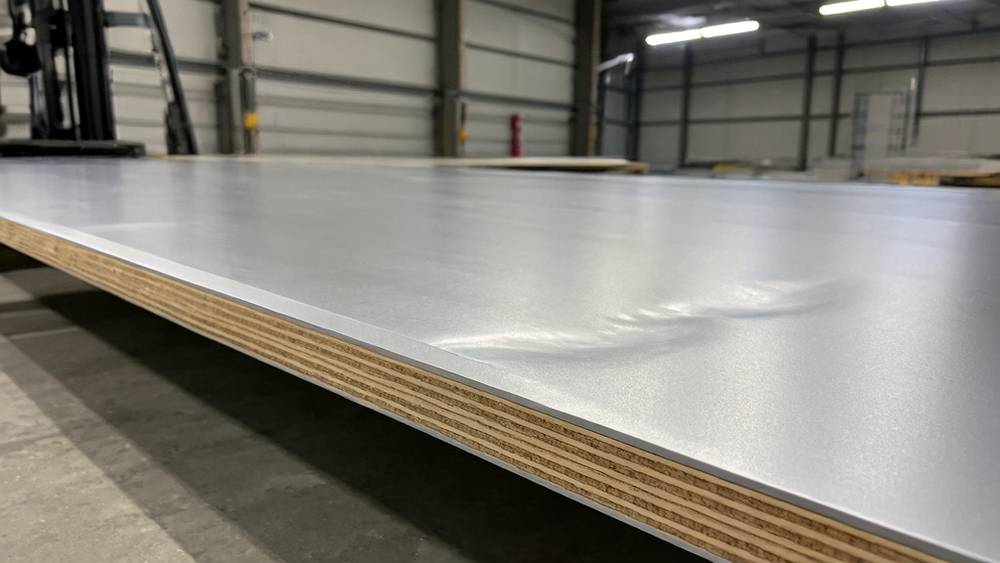
Laminated aluminum panels used in industrial settings differ fundamentally from the aluminum composite materials (ACM) found on office towers. The typical industrial panel sandwiches a structural plywood core — usually 9 mm to 18 mm thick — between aluminum skins ranging from 0.5 mm to 1.2 mm on each face. Bonding is achieved through heat-activated polyurethane or epoxy adhesives applied under controlled pressure, creating a monolithic panel that resists delamination even under repeated impact cycles.
The aluminum skins are not decorative. In these applications, the metal face serves as the primary sacrificial layer. A 0.8 mm aluminum skin can absorb and distribute point-impact energy across the plywood substrate, preventing the kind of localized crushing that would occur if the same force hit bare plywood. The back face, often a thinner 0.5 mm skin, provides a moisture barrier and balances the panel to minimize warping. This is not a product category where you can substitute gauge thickness without recalculating impact performance — a mistake made frequently when value-engineering exercises trim aluminum thickness to cut cost per square meter.
Manufacturers like Futeng® produce these panels under ISO 9001-certified processes, ensuring that adhesive coverage exceeds 95% across the bond line — a critical quality metric since voids in the adhesive layer become crack initiation points under repeated impact loads.
Why Impact Testing Data Matters More Than Static Load Ratings
Static load tables — wind load, dead load, snow load — dominate most cladding specification documents. For interior industrial walls, these numbers are largely irrelevant. A partition wall inside a warehouse never sees 3 kPa of wind suction. It does, however, get hit by a 2,200 kg forklift counterweight swinging into it during a tight turn.
The relevant test standard is ASTM E1886, which covers impact resistance of building envelopes and interior partitions. For industrial panels, the large-missile impact test (a 4.1 kg 2×4 lumber projectile at approximately 24 km/h) provides a useful proxy for the kind of blunt trauma these panels endure. Panels that pass this test without perforation and with limited back-face deformation are suitable for high-traffic zones.
Less commonly referenced but equally relevant is ISO 7892, which covers vertical building elements under soft and hard body impacts. For industrial laminated aluminum panels, the hard-body impact test (a 500 g steel ball dropped from 1.0 m) simulates tool strikes and dropped equipment. A panel that survives this with only a superficial dent — no core fracture, no skin tearing — earns its place on a factory floor.
The disconnect between specification practice and real-world performance becomes stark when you examine post-installation failure data. A 2022 survey by the Metal Construction Association documented that impact-related damage accounted for 37% of industrial interior panel replacements within the first five years of service, compared to only 8% attributed to corrosion or delamination. The panels that failed early shared a common profile: aluminum skins below 0.6 mm and plywood cores below 12 mm.
Core Material Selection and Its Direct Effect on Impact Behavior
Not all plywood cores behave identically under impact. The key variables are species, ply count, and adhesive type within the core itself. Here is where the specification language gets slippery: a "plywood core" can range from 5-ply poplar (soft, absorbent, cheap) to 11-ply Baltic birch (dense, rigid, expensive). The difference in impact performance between these two extremes is not marginal — it is roughly 2.5× in energy absorption capacity.
Plywood Core Grades and Impact Performance
| Core Type | Typical Ply Count (18 mm) | Density (kg/m³) | Relative Impact Energy Absorption | Typical Application |
|---|---|---|---|---|
| Poplar / Mixed Hardwood | 5-7 ply | 420-480 | Baseline (1.0×) | Light-duty office partitions |
| Eucalyptus / Tropical Hardwood | 9-11 ply | 550-620 | ~1.6× | General warehouse walls |
| Baltic Birch (Betula spp.) | 11-13 ply | 640-700 | ~2.3× | Heavy industrial, cold storage |
| Marine-Grade Ply (BS 1088) | 9-13 ply | 580-680 | ~2.1× | Food processing, wet zones |
The ply count matters because each glue line within the plywood acts as a crack arrestor. An 11-ply core has 10 internal glue lines; a 5-ply core has only 4. Under impact, the dense network of adhesive layers in high-ply-count cores prevents cracks from propagating through the full panel thickness. The panel may dent but it will not snap.
Marine-grade plywood — conforming to BS 1088 — adds another dimension: moisture-resistant phenolic adhesives that maintain bond integrity even when the panel absorbs humidity. In food processing facilities where washdown procedures expose wall panels to water and cleaning chemicals daily, this matters. A standard urea-formaldehyde bonded plywood core will lose up to 40% of its impact resistance after repeated moisture cycling; a phenolic-bonded marine core loses less than 10%.
Skin Thickness and Dent Resistance: A Quantified Relationship
The aluminum skin thickness on laminated aluminum panels directly governs dent depth under a given impact energy. This relationship follows a roughly inverse-square law: doubling skin thickness reduces dent depth by approximately 75%, not 50%, because the thicker skin engages a wider area of the plywood substrate in distributing the impact load.
Field measurements from industrial installations reveal the practical implications:
- 0.5 mm aluminum skin: Visible dents from impacts exceeding 8 Joules (roughly a 1 kg hammer dropped from 0.8 m). Dents typically penetrate 2-3 mm and often crack the paint film, initiating corrosion.
- 0.8 mm aluminum skin: Dent threshold rises to approximately 18 Joules. Paint cracking is rare below 25 Joules. This is the practical minimum for forklift-adjacent walls.
- 1.0 mm aluminum skin: Dent threshold around 30 Joules. Suitable for loading dock areas and machinery enclosures where impact risk is continuous.
- 1.2 mm aluminum skin: Dent threshold exceeds 45 Joules. Used in heavy industrial applications — foundries, steel service centers, vehicle maintenance bays.
The cost increment from 0.5 mm to 1.0 mm aluminum skin is approximately 35-45% on the material side, but the lifecycle cost analysis tilts decisively in favor of the thicker skin. Replacing a single damaged panel in an operating industrial facility costs 4-7× the original panel material cost when you account for labor, downtime, and access equipment. If the thicker skin prevents even one replacement event per 50 panels over 15 years, the economics justify the upgrade.
Adhesive Systems: The Hidden Variable in Impact Durability
The adhesive layer bonding aluminum to plywood is typically 0.1-0.3 mm thick — nearly invisible in cross-section, but decisive in impact performance. Three adhesive chemistries dominate the market:
Polyurethane (PUR) reactive hot-melt adhesives are the most common. They cure by reacting with ambient moisture, forming a tough, slightly flexible bond line. Under impact, this flexibility is an advantage: the adhesive can stretch up to 15-20% elongation before cohesive failure, absorbing energy rather than transmitting it directly to the core. The downside is temperature sensitivity — bond strength drops measurably above 80°C, which rules out certain industrial environments (foundries, kilns, autoclave rooms).
Epoxy-based adhesives offer higher ultimate bond strength and better thermal resistance (stable to 120°C+), but with lower elongation (typically 3-5%). Under sharp impact, an epoxy bond line can fail in brittle fracture, delaminating the aluminum skin from the core in a manner that is difficult to detect visually until corrosion stains appear at the panel edge months later.
Modified silane (MS) polymer adhesives represent a middle ground: elongation comparable to PUR (12-18%), thermal stability to 100°C, and the added benefit of being solvent-free and isocyanate-free — a specification advantage in food industry applications where volatile organic compound (VOC) restrictions apply.
"The adhesive is not just a joining medium; it is a structural element in the impact load path. Specifying the panel without specifying the adhesive system is like specifying a concrete mix without mentioning the cement type." — This observation, shared by a senior façade engineer with 25 years in industrial cladding, captures why procurement documents that simply call for 'laminated aluminum panels' without adhesive requirements are incomplete.
Installation Details That Make or Break Impact Performance
Even the toughest panel becomes vulnerable if installed incorrectly. Three installation factors directly influence how laminated aluminum panels respond to impact loads:
Fastener Spacing and Edge Distance
A panel fastened at 600 mm centers will deflect more under impact than one fastened at 400 mm centers, and that additional deflection translates into higher peak stress at the impact point. For industrial walls where impact risk is moderate to high, fastener spacing should not exceed 400 mm along panel edges and 500 mm in the field. Edge distance — the distance from the fastener center to the panel edge — should be a minimum of 20 mm for panels with aluminum skins 0.8 mm and thicker, and 25 mm for thinner skins. Fasteners placed too close to the edge create a shear-out failure mode where the plywood core splits before the aluminum skin yields.
Substrate and Framing Alignment
Industrial walls are often framed with cold-formed steel studs at variable spacing. If a panel spans across two studs that are not in the same plane — a 3 mm offset is enough — the panel is pre-stressed before it ever sees an impact. This pre-stress reduces the energy the panel can absorb before reaching its failure threshold. Laser-leveling of the substrate to a tolerance of ±2 mm over 3 m is a reasonable specification requirement that directly extends panel service life.
Joint Design and Load Transfer
Panels installed with tight butt joints transfer impact energy to adjacent panels, spreading the damage. A 3-5 mm nominal joint filled with a flexible polyurethane sealant allows each panel to move independently under impact, localizing damage to the struck panel and making replacement simpler. The trade-off is aesthetics — open joints are visually prominent — but in an industrial setting, maintainability generally trumps appearance.
Chemical Exposure and Its Effect on Impact Longevity
Industrial environments expose panels to substances that degrade both the aluminum skin and the plywood core over time. The impact resistance of a panel on day one is not the same as its impact resistance after five years of exposure to diesel fumes, cutting fluids, or cleaning agents.
Aluminum skins with a PVDF (polyvinylidene fluoride) coil coating — typically 25-35 microns dry film thickness — resist most industrial chemicals, but the cut edges of the panel remain vulnerable. Edge-sealing with a two-part epoxy primer during fabrication is a low-cost step (approximately $0.50 per linear meter of panel edge) that prevents chemical wicking into the plywood core, a degradation mechanism that can reduce impact resistance by 30% or more over a decade.
For panels in food processing or pharmaceutical facilities, where hydrogen peroxide or peracetic acid sanitizers are common, a 304 or 316 stainless steel skin in lieu of aluminum may be specified. However, stainless-laminated panels are 2-3× the cost and significantly heavier. A more economical alternative is a 1.0 mm aluminum skin with a high-build epoxy coating (80-120 microns) that provides a chemically resistant barrier at roughly 60% of the stainless panel cost.
The aluminum surface finish also affects long-term impact resilience. Anodized finishes — commonly 15-25 microns thick — are harder than PVDF coatings but more brittle. Under impact, an anodized surface can micro-crack, creating pathways for moisture and chemicals. PVDF coatings are more ductile and tend to deform with the aluminum rather than fracture, preserving the protective barrier even in dented areas.
Specifying Laminated Aluminum Panels for Industrial Impact Zones: A Practical Checklist
Based on the analysis above, a specification for laminated aluminum panels in industrial impact zones should address these points:
- Aluminum skin thickness: 0.8 mm minimum for general industrial walls; 1.0 mm for forklift zones and loading docks; 1.2 mm for heavy machinery areas.
- Plywood core: Minimum 9-ply construction, 15-18 mm overall thickness, bonded with moisture-resistant adhesive (phenolic or equivalent). Baltic birch or marine-grade for wet or washdown environments.
- Adhesive system: Polyurethane or modified silane for general use; epoxy only where sustained temperatures exceed 80°C and impact risk is low.
- Impact certification: Require test data per ASTM E1886 (large missile) or ISO 7892 (hard body) for the specific panel construction being supplied, not a generic product line brochure.
- Edge treatment: All cut edges sealed with two-part epoxy primer prior to installation.
- Fastener schedule: Maximum 400 mm edge spacing, minimum 20 mm edge distance for skins ≥0.8 mm.
- Substrate tolerance: ±2 mm over 3 m, verified by laser survey before panel installation begins.
- Joint width: 3-5 mm minimum, filled with flexible polyurethane sealant where hygiene permits; open joints where impact energy isolation is prioritized.
This checklist is not theoretical. It derives from post-mortem analyses of industrial panel failures where a single omitted requirement — edge sealing, or an extra 0.2 mm of aluminum — turned a 20-year asset into a 5-year liability.
The Cost of Getting It Wrong
Panel replacement in an active industrial facility is expensive in ways that initial procurement budgets rarely capture. A $45/m² panel can cost $280-350/m² to replace when the work requires shutting down a production line, erecting scaffolding, and coordinating with safety officers. Multiply that across a 1,500 m² wall area with a 15% annual damage rate, and the lifecycle cost of under-specified panels dwarfs any upfront savings.
Suppliers with deep industrial experience — Futeng® among them — maintain technical documentation that goes beyond standard datasheets, offering impact test reports, adhesive compatibility charts, and substrate preparation guidelines. When evaluating panel suppliers for an industrial project, the presence or absence of this level of technical support is a reliable indicator of whether the manufacturer understands the difference between a decorative wall panel and an industrial workhorse.
Laminated aluminum panels in industrial service are not a commodity product differentiated only by price per square meter. They are engineered assemblies where every layer — aluminum skin, adhesive, plywood core, edge treatment — contributes to or detracts from impact survival. Specifying them properly requires looking past the finish sample and into the test data, the ply count, and the installation tolerances. The forklift driver at 3 AM will never read the specification. But the specification determines whether his next collision leaves a barely noticeable scuff or a hole that shuts down the line.